Dave Clarke, an award-winning editor and editorial director in the marketing departments of Fortune 500 companies such as Oracle and Symantec provides the following five tips to community bank social media usage as a guest blogger on Hubspot.com.
1. Understand that, while social media creates a virtual community, it takes real time to properly service and manage your social media. Time management is crucial. Create a strategy for what types of messages will be posted, by whom, and how often. Don’t limit your marketing to banking topics only. Keep the community front and center, too in your social media efforts.
2. Get your internal policy right. Make sure staff across the bank understand how social media works in a business setting and how that intersects with their professional responsibilities.
3. Read everything. Social media platforms are constantly evolving and changing. Just when you think you have a platform mastered, the technology, user demographics or even the jargon associated with those channels can shift.
4. A picture may be worth 1,000 words, but with banking regulations being what they are, the privacy policies guiding their posting (especially if they include customers) can be 10 times that. Work with your legal department to streamline the process to get photos posted in a timely manner. Photos of community bankers out in the community are one of the most valuable tools for conveying the bank’s commitment to the community at large.
5. Be sure executive management, IT, and marketing are all behind your social media efforts. Without any one of them, your social media campaign cannot succeed.
An additional resource for community banks is the 2008 (dated but still relevant!) Community Banker's Guide to Social Network Marketing as well as the Human Resources Guide to Social Media Risks.
Wednesday, September 7, 2011


Third Federal Bank Uses Mascot and Social Media to Create Community
3rd Fred, the lime green, amorphous mascot of Third Federal Bank, has gone missing and the Bank is using social media to get its customers and prospective customers to help to find him. The marketing campaign coincides with Third Federal’s 90th anniversary. The Bank’s marketing team created a series of Internet videos and is using social media sites such as Twitter and YouTube to get out the word. The effort has captured the attention of the American Bankers Association, which mentioned the campaign in a post on its Banking Journal website.

Check out the videos here.
Check out the videos here.
Monday, September 5, 2011
Financial Services Roundtable Releases "Social Media Risks and Mitigation"
EXECUTIVE SUMMARY
 |
| Social Media and Risk Mitigation - June 2011 |
This paper is intended for a general audience, from business practitioners to compliance, risk and legal professionals, primarily from a United States perspective. It provides a synopsis of the major themes an FI should consider when using and deploying social media and is best used as a reference guide, delving into the situation or organizational section that is most appropriate to the reader. To assist readers in identifying which sections are most applicable to their purpose and expertise, a risk matrix is provided in Appendix E.
This paper addresses risks and mitigation methods for financial institutions using social media from three perspectives: To communicate with or service customers, By employees within a financial institution in personal and professional capacities, and By employees or contractors outside the office.
Sunday, August 28, 2011
Corporate Insight Finds Twitter Now More Popular than Facebook with Financial Services Firms
According to Corporate Insight, Twitter has surpassed Facebook as the most popular third-party network employed by financial services companies. While only 15% of the firms they tracked had a Twitter profile in the fall of 2008, that number grew to 57% by October 2010. Since then, they have been tracking statistics related to the social media properties on a monthly basis. Their findings demonstrate that Twitter continues to gain in popularity. As of August 1st, 67% of the firms Corporate Insight tracks now have a presence on Twitter, a 10% increase in as many months. During the same time, the percentage of financial services firms with Facebook pages increased by 3% to 59% of the industry.
Wednesday, June 8, 2011
FAIR DEBT COLLECTION PRACTICES ACT AND SOCIAL NETWORKS
As social media use has become ubiquitous, industries have been hard at work determining how to best take advantage of the often-frequented social network communities. With Facebook at over 500 million active users, Twitter processing over 155 million tweets per day and LinkedIn with over 100 million registered professionals, it is no wonder organizations are looking for ways to leverage what social networks bring - people.
One industry that believes it has found a great use for social media is the debt collection industry. Many debt collectors find social networks extremely helpful for obtaining crucial information such as debtor’s home and work locations, lifestyle expenditures, lists of friends and family, determining whether a debtor has the financial wherewithal to make payments on a defaulted debt, and as a result, whether a debtor is worth the expense of suing in court. Debt collectors also find social networks useful in communicating with debtors in a manner that may be more effective than mail or telephone. Unfortunately for collectors, social networks have their drawbacks - drawbacks that can lead to legal action, regulatory criticism and reputational harm.
 Nearly 35 years ago Congress passed the Fair Debt Collection Practices Act of 1977 (“FDCPA”) (15 U.S.C. §§ 1692-1692p). The FDCPA was passed by Congress in response to certain questionable and unethical tactics used by debt collectors. Prior to the passing of the FDCPA it was not uncommon to have debt collectors disclose to the friends and family of delinquent borrowers, the delinquent status of a loan. Other unethical tactics included making threatening, misleading and other statements to debtors with the intent of forcing repayment. The FDCPA was essentially enacted to protect consumers from the harassment, both verbal and psychological, that frequently accompanied collection efforts. While the FDCPA generally defines debt collectors as agents/contractors engaged to collect debts on behalf of others, this article assumes debt collectors to be agents/contractors as well as the owners of the debt such as banks, finance companies and investors because, while the federal FDCPA narrowly defines debt collectors, many state collection laws that mirror the federal FDCPA define debt collectors as anyone that collects a debt.
The FDCPA was passed by Congress seven years before Facebook founder Mark Zuckerberg was born. Twitter founder Jack Dorsey was one year old and MySpace co-founder Tom Anderson was seven years old when the FDCPA was put into place. As such, today’s social media explosion could not have been anticipated by the framers of the FDCPA. Many experts in the debt collection field believe that due to the FDCPA’s age the law requires a revision to specifically address social media. According to these experts, debt collectors are operating in a “no man’s land” - the equivalent of the Wild West. These experts believe that without social media-specific guidance, the debt collection industry is at risk of extensive litigation brought by private parties and class action plaintiffs’ attorneys.
The Federal Trade Commission (“FTC”), the federal agency with authority to enforce the FDCPA, has not indicated that it will revise the FDCPA any time soon. Instead, the FTC has stated that the consumer protections included in the FDCPA are sufficient to protect consumers and that the FDCPA addresses all forms of communications, including communications initiated through social networks and other social media. According the the FTC, the FDCPA includes sufficient guidance to prevent harassment of debtors and improper communication.

As such, the FTC disagrees with debt collection experts that are calling for an amendment to the FDCPA relative to social media. As demonstrated below, it appears that debt collector’s challenges relative to social media appear to be due to a lack of understanding of the FDCPA or blatant disregard for the Act.
In August 2010, Florida resident Melanie Beacham sued debt collection agency MarkOne Financial LLC after the debt collector used Facebook to allegedly harass the consumer who was delinquent on an auto loan. According to the lawsuit, in addition to aggressively using traditional collection methods, the debt collector also used Facebook’s messaging function to contact the delinquent borrower as well as to contact her relatives to ask that they have her contact the collection agency. According to the lawsuit, MarkOne Financial LLC used Facebook to intentionally harass the debtor in an “outrageous format.”
The debtor, who fell behind on her loan payment during a medical leave from her job, stated that she was shocked when she learned that the debt collectors used Facebook to track down her whereabouts and contact her family. The debtor claimed significant embarrassment related to the disclosure of her bad debt to her family.
In April 2011, while the lawsuit remained pending, W. Douglas Baird, the Judge hearing the complaint, ordered MarkOne Financial LLC to cease the use of social networks for the purpose of contacting the debtor and the debtor’s family and friends. The order, considered groundbreaking by many in the field of debt collection, shows how social media is increasingly becoming the basis for lawsuits. The challenge to debt collectors that use social networks is not so much federal and state collections laws do not address the use of social media. Instead, the challenge is one of compliance and training.
While social media is widely used, many users, including debt collectors, do not fully understand the functionality and impact of many social media features. As in the example above, debt collectors may locate a debtor on Facebook (or any other social network) and may make use of the “Send Message” function provided. This feature allows the sender to send a confidential message to the recipient similar to an email. As this feature requires little effort on the part of the debt collector, it is possible to abuse this feature by repeatedly sending messages to the debtor - an act that may violate § 1692d of the FDCPA, which defines harassment or abuse as “any conduct the natural consequence of which is to harass, oppress, or abuse any person in connection with the collection of a debt.” As such, in order to avoid a violation of § 1692d, debt collectors should observe their firm’s FDCPA policy relative to phone calls and treat social network messages as a similar communication when using the messaging feature on a social network.

In addition to sending messages to the debtor, it is possible for debt collectors to send messages to the friends and family members of the debtor that are part of the debtor’s social circle. This functionality allows debt collectors to contact third parties for assistance in obtaining information about the debtor, a permissible act according to § 1692b of the FDCPA. However, debt collectors using the messaging function to contact friends and family of the debtor must comply with the FDCPA. As such, any communication with friends and family through a social network requires the following of the debt collector:
(1) Identify himself, state that he is confirming or correcting location information concerning the consumer, and, only if expressly requested, identify his employer;
(2) Not state that such consumer owes any debt;
(3) Not communicate with any such person more than once unless requested to do so by such person or unless the debt collector reasonably believes that the earlier response of such person is erroneous or incomplete and that such person now has correct or complete location information;
(4) Not communicate by post card. In the case of social media, this should also include not posting any messages on the “Wall” of the debtor or the debtor’s friends and family. A postcard has the effect of openly disclosing a debt. A “Wall” posting is a digital equivalent;
(5) Not use any language or symbol on any envelope or in the contents of any communication effected by the mails or telegram that indicates that the debt collector is in the debt collection business or that the communication relates to the collection of a debt. While a social network message is not physical mail, it is the equivalent of electronic mail. As such, the debt collector should ensure that any message fully complies with this requirement; and,
(6) After the debt collector knows the consumer is represented by an attorney with regard to the subject debt and has knowledge of, or can readily ascertain, such attorney’s name and address, not communicate with any person other than that attorney, unless the attorney fails to respond within a reasonable period of time to the communication from the debt collector.
Debt collectors must ensure that their use of social media and social networks conforms to the spirit and intent of the FDCPA. Based upon the general language of the FDCPA, acts of noncompliance are generally the result of inadequate training or blatant disregard for the FDCPA - not shortcomings in the FDCPA language.
One industry that believes it has found a great use for social media is the debt collection industry. Many debt collectors find social networks extremely helpful for obtaining crucial information such as debtor’s home and work locations, lifestyle expenditures, lists of friends and family, determining whether a debtor has the financial wherewithal to make payments on a defaulted debt, and as a result, whether a debtor is worth the expense of suing in court. Debt collectors also find social networks useful in communicating with debtors in a manner that may be more effective than mail or telephone. Unfortunately for collectors, social networks have their drawbacks - drawbacks that can lead to legal action, regulatory criticism and reputational harm.
The FDCPA was passed by Congress seven years before Facebook founder Mark Zuckerberg was born. Twitter founder Jack Dorsey was one year old and MySpace co-founder Tom Anderson was seven years old when the FDCPA was put into place. As such, today’s social media explosion could not have been anticipated by the framers of the FDCPA. Many experts in the debt collection field believe that due to the FDCPA’s age the law requires a revision to specifically address social media. According to these experts, debt collectors are operating in a “no man’s land” - the equivalent of the Wild West. These experts believe that without social media-specific guidance, the debt collection industry is at risk of extensive litigation brought by private parties and class action plaintiffs’ attorneys.
The Federal Trade Commission (“FTC”), the federal agency with authority to enforce the FDCPA, has not indicated that it will revise the FDCPA any time soon. Instead, the FTC has stated that the consumer protections included in the FDCPA are sufficient to protect consumers and that the FDCPA addresses all forms of communications, including communications initiated through social networks and other social media. According the the FTC, the FDCPA includes sufficient guidance to prevent harassment of debtors and improper communication.
As such, the FTC disagrees with debt collection experts that are calling for an amendment to the FDCPA relative to social media. As demonstrated below, it appears that debt collector’s challenges relative to social media appear to be due to a lack of understanding of the FDCPA or blatant disregard for the Act.
In August 2010, Florida resident Melanie Beacham sued debt collection agency MarkOne Financial LLC after the debt collector used Facebook to allegedly harass the consumer who was delinquent on an auto loan. According to the lawsuit, in addition to aggressively using traditional collection methods, the debt collector also used Facebook’s messaging function to contact the delinquent borrower as well as to contact her relatives to ask that they have her contact the collection agency. According to the lawsuit, MarkOne Financial LLC used Facebook to intentionally harass the debtor in an “outrageous format.”
The debtor, who fell behind on her loan payment during a medical leave from her job, stated that she was shocked when she learned that the debt collectors used Facebook to track down her whereabouts and contact her family. The debtor claimed significant embarrassment related to the disclosure of her bad debt to her family.
In April 2011, while the lawsuit remained pending, W. Douglas Baird, the Judge hearing the complaint, ordered MarkOne Financial LLC to cease the use of social networks for the purpose of contacting the debtor and the debtor’s family and friends. The order, considered groundbreaking by many in the field of debt collection, shows how social media is increasingly becoming the basis for lawsuits. The challenge to debt collectors that use social networks is not so much federal and state collections laws do not address the use of social media. Instead, the challenge is one of compliance and training.
While social media is widely used, many users, including debt collectors, do not fully understand the functionality and impact of many social media features. As in the example above, debt collectors may locate a debtor on Facebook (or any other social network) and may make use of the “Send Message” function provided. This feature allows the sender to send a confidential message to the recipient similar to an email. As this feature requires little effort on the part of the debt collector, it is possible to abuse this feature by repeatedly sending messages to the debtor - an act that may violate § 1692d of the FDCPA, which defines harassment or abuse as “any conduct the natural consequence of which is to harass, oppress, or abuse any person in connection with the collection of a debt.” As such, in order to avoid a violation of § 1692d, debt collectors should observe their firm’s FDCPA policy relative to phone calls and treat social network messages as a similar communication when using the messaging feature on a social network.
In addition to sending messages to the debtor, it is possible for debt collectors to send messages to the friends and family members of the debtor that are part of the debtor’s social circle. This functionality allows debt collectors to contact third parties for assistance in obtaining information about the debtor, a permissible act according to § 1692b of the FDCPA. However, debt collectors using the messaging function to contact friends and family of the debtor must comply with the FDCPA. As such, any communication with friends and family through a social network requires the following of the debt collector:
(1) Identify himself, state that he is confirming or correcting location information concerning the consumer, and, only if expressly requested, identify his employer;
(2) Not state that such consumer owes any debt;
(3) Not communicate with any such person more than once unless requested to do so by such person or unless the debt collector reasonably believes that the earlier response of such person is erroneous or incomplete and that such person now has correct or complete location information;
(4) Not communicate by post card. In the case of social media, this should also include not posting any messages on the “Wall” of the debtor or the debtor’s friends and family. A postcard has the effect of openly disclosing a debt. A “Wall” posting is a digital equivalent;
(5) Not use any language or symbol on any envelope or in the contents of any communication effected by the mails or telegram that indicates that the debt collector is in the debt collection business or that the communication relates to the collection of a debt. While a social network message is not physical mail, it is the equivalent of electronic mail. As such, the debt collector should ensure that any message fully complies with this requirement; and,
(6) After the debt collector knows the consumer is represented by an attorney with regard to the subject debt and has knowledge of, or can readily ascertain, such attorney’s name and address, not communicate with any person other than that attorney, unless the attorney fails to respond within a reasonable period of time to the communication from the debt collector.
Debt collectors must ensure that their use of social media and social networks conforms to the spirit and intent of the FDCPA. Based upon the general language of the FDCPA, acts of noncompliance are generally the result of inadequate training or blatant disregard for the FDCPA - not shortcomings in the FDCPA language.
Monday, February 14, 2011
Your Brand? Let's Try That Again.
Adam R. Jacobson quotes Lee Vann of Captura Group in his The 2010 U.S. Hispanic Social Media & Marketing Overview, "...the right approach is ultimately developing a social media strategy that drives value - and minimizes the fear of yielding some control to the consumer..."


Over the past two to three years most organizations have concluded that social media can provide a reasonable, if not, tremendous return on investment, despite the difficulty in coming to an agreement regarding how to best measure ROI.
More than anything else, these days it appears that the control of the brand and the associated reputational risks are what keep executives from fully diving in. There exists a fear among many executives and other stakeholders that entering the world of social media means giving up control of the message and of the brand. But what these people have failed to realize is that they already lost control of their brand - regardless of their adoption of social media.
Web 2.0 developed a bond among peers. This peer-to-peer phenomenon is what recently created historic change in Egypt. The same peer-to-peer phenomenon that took messaging/influencing control away from Egypt and gave it to its citizens, has similarly affected EVERY organization's ability to control its brand. As social networks, microblogs, blogs, peer review sites and other social media platforms continue to gain popularity, organizations continue to lose control.
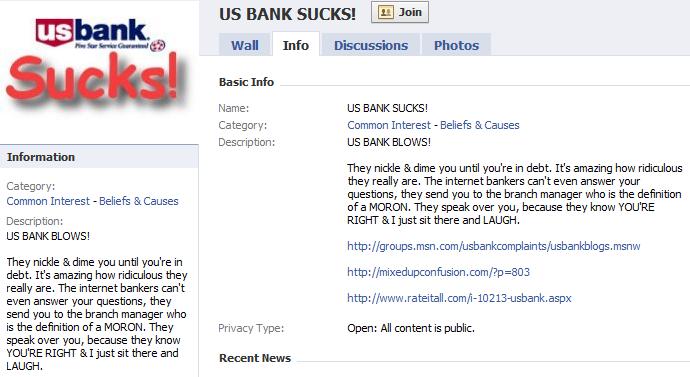
Two easy social media and banking examples of the loss of control are the U.S. Bank Sucks and Bank of America Sucks Facebook pages. In both cases the banks have lost the ability to completely control the messaging. In these examples, peers are sharing with other peers their experiences for the collective benefit of the "community." Once these experiences are documented, consumers can compare the collective experience of the community to the messaging being delivered by the organizations to determine next steps.
More than anything else, these days it appears that the control of the brand and the associated reputational risks are what keep executives from fully diving in. There exists a fear among many executives and other stakeholders that entering the world of social media means giving up control of the message and of the brand. But what these people have failed to realize is that they already lost control of their brand - regardless of their adoption of social media.
Web 2.0 developed a bond among peers. This peer-to-peer phenomenon is what recently created historic change in Egypt. The same peer-to-peer phenomenon that took messaging/influencing control away from Egypt and gave it to its citizens, has similarly affected EVERY organization's ability to control its brand. As social networks, microblogs, blogs, peer review sites and other social media platforms continue to gain popularity, organizations continue to lose control.
 |
| Egyptian Citizens Take Control Through Peer-to-Peer Social Media Tools |
Organizations' biggest challenge is getting their heads around the fact that they no longer have total control of the brand. In this environment, organizations are challenged to be the best they possibly can be in order to minimize harm to the reputation of the organization.
Fortunately for those that deserve it, the loss of brand does not always have to work against an organization. In her blog post "SXSW: Rules Of Brand Fiction From Twittering Mad Men," Janneane Blevins demonstrates that loss of control over the brand can also provide positive outcomes. In this case, some fans (not the producers) of the television hit "Mad Men" created social media personas for the Mad Men characters. These individuals enhanced and created further demand for the Mad Men brand. According to Ms. Blevins, the fans that created the social media personas of Mad Men characters "were able to use brand fiction to engage a whole new audience."
 Therefore, organizations need to get over the issue of control - and quickly. Organizations no longer hold the same control over the messaging and their brand. Whether or not an organization is actively using social media, social media may be actively using the organization. The best approach to getting over the fear of the unknown is for organizations to become familiar with the risks and then develop a strategy that fits the organization's risk appetite.
Doing nothing and ignoring the influence of social media is no longer an option and may be considered a form of negligence.

Doing nothing and ignoring the influence of social media is no longer an option and may be considered a form of negligence.
Sunday, February 6, 2011
Your Neighbor Hates the Bank....You're Fired!
About once per year there occurs a social media-related event that gets the social media talking heads (myself included), well, talking.
This year's first nominee for the 2011 Social Media "Oh No You Didn't" Award goes to Commonwealth Bank in Australia.
The Australian newspaper titled its coverage of the story, "Bank Threatens Staff with Sack Over Social Media Comments." The gist of the story is this...Commonwealth Bank published a social media policy that essentially "deputized" employees with the mission of reporting and eliminating any adverse social media comments - or possibly face the executioner (Human Resources Manager).

According to the published story, "bank employees have been told they must immediately notify their manager if they become aware of 'inappropriate or disparaging content and information stored or posted by others', including non-employees, in the 'social media environment'."
The policy holds employees accountable for the actions of third parties. According to The Australian report, the policy state: "For example, your friend could post an inappropriate comment about the group on your Facebook page or create a blog about the group."
As if holding employees accountable for the acts of others isn't bad enough, the policy then goes on to state that "failure to comply with this policy is a serious disciplinary matter and may result in disciplinary action being taken against you, which may include the termination of your employment."
Sounds to me like whoever drafted this policy did not have a good understanding of how social media works. But even worse, this person did not know the advantages that comes with openly addressing criticism.
Back on December 17th I posted "Firing An Employee Bad Mouthing the Company on Social Media? Better Think Twice." While the December 17th post relates primarily to U.S. incidents, there is much that applies to any locale. As such, it was no surprise when the Australian Finance Sector Union demanded suspension of the bank's new social media policy, accusing it of trying to restrict freedom of expression.
Quite honestly, I was shocked when I heard about this incident. At this stage in the game most corporations should at least know the basics of social media and employee relations - or at least ask someone that does before putting out such a draconian policy. On the other hand, I suppose this need for education bodes well for me as just last month I released a new book, "Human Resources Guide to Social Media Risks" (shameless plug!).

I hate to break it to Commonwealth Bank but they just made it onto every social media consultant's Powerpoint deck. I'm sure the story does not end here. Let me know what you think and hear.
This year's first nominee for the 2011 Social Media "Oh No You Didn't" Award goes to Commonwealth Bank in Australia.
The Australian newspaper titled its coverage of the story, "Bank Threatens Staff with Sack Over Social Media Comments." The gist of the story is this...Commonwealth Bank published a social media policy that essentially "deputized" employees with the mission of reporting and eliminating any adverse social media comments - or possibly face the executioner (Human Resources Manager).
According to the published story, "bank employees have been told they must immediately notify their manager if they become aware of 'inappropriate or disparaging content and information stored or posted by others', including non-employees, in the 'social media environment'."
The policy holds employees accountable for the actions of third parties. According to The Australian report, the policy state: "For example, your friend could post an inappropriate comment about the group on your Facebook page or create a blog about the group."
As if holding employees accountable for the acts of others isn't bad enough, the policy then goes on to state that "failure to comply with this policy is a serious disciplinary matter and may result in disciplinary action being taken against you, which may include the termination of your employment."
Sounds to me like whoever drafted this policy did not have a good understanding of how social media works. But even worse, this person did not know the advantages that comes with openly addressing criticism.
Back on December 17th I posted "Firing An Employee Bad Mouthing the Company on Social Media? Better Think Twice." While the December 17th post relates primarily to U.S. incidents, there is much that applies to any locale. As such, it was no surprise when the Australian Finance Sector Union demanded suspension of the bank's new social media policy, accusing it of trying to restrict freedom of expression.
Quite honestly, I was shocked when I heard about this incident. At this stage in the game most corporations should at least know the basics of social media and employee relations - or at least ask someone that does before putting out such a draconian policy. On the other hand, I suppose this need for education bodes well for me as just last month I released a new book, "Human Resources Guide to Social Media Risks" (shameless plug!).
I hate to break it to Commonwealth Bank but they just made it onto every social media consultant's Powerpoint deck. I'm sure the story does not end here. Let me know what you think and hear.
Subscribe to:
Posts (Atom)