Showing posts with label social network. Show all posts

Thursday, July 19, 2012

Harnessing the Power of Social Media

In his article, "How Banks Can Harness the Power of Social Media," Tom Bukacek, CEO of Black Box Social Media LLC summarizes nicely the best way community banks should use social media.

Social Media Marketing And SEO For Business

According to Bukacek, banks have been slow to adopt social media in recent years due to factors such as ROI, risks and understanding how to best use social networks.  But this is changing every day.

Bukacek makes a strong point:  "CONSUMER INTERACTION CAN  ONLY OCCUR AT THE SMALLER COMMUNITY LEVEL."  

BINGO!!!!!!

Bukacek goes on to explain that the "sharing of experiences and stories brings the banks closer to customers and also ends up becoming a valuable source of information about consumer preferences."  He also addresses the issue of "negative feedback" by stating that a well handled social media crisis can result in a very positive outcome.

These are all simple but important rules when using social media in a community bank setting.  Forget the big and expensive national campaigns of the multinational banks.  Instead focus on micro-marketing through social media.  Win over new customers and turn existing customers into brand ambassadors and evangelists for your brand.


Wednesday, June 8, 2011

FAIR DEBT COLLECTION PRACTICES ACT AND SOCIAL NETWORKS

As social media use has become ubiquitous, industries have been hard at work determining how to best take advantage of the often-frequented social network communities. With Facebook at over 500 million active users, Twitter processing over 155 million tweets per day and LinkedIn with over 100 million registered professionals, it is no wonder organizations are looking for ways to leverage what social networks bring - people.

One industry that believes it has found a great use for social media is the debt collection industry. Many debt collectors find social networks extremely helpful for obtaining crucial information such as debtor’s home and work locations, lifestyle expenditures, lists of friends and family, determining whether a debtor has the financial wherewithal to make payments on a defaulted debt, and as a result, whether a debtor is worth the expense of suing in court. Debt collectors also find social networks useful in communicating with debtors in a manner that may be more effective than mail or telephone. Unfortunately for collectors, social networks have their drawbacks - drawbacks that can lead to legal action, regulatory criticism and reputational harm.

Nearly 35 years ago Congress passed the Fair Debt Collection Practices Act of 1977 (“FDCPA”) (15 U.S.C. §§ 1692-1692p). The FDCPA was passed by Congress in response to certain questionable and unethical tactics used by debt collectors. Prior to the passing of the FDCPA it was not uncommon to have debt collectors disclose to the friends and family of delinquent borrowers, the delinquent status of a loan. Other unethical tactics included making threatening, misleading and other statements to debtors with the intent of forcing repayment. The FDCPA was essentially enacted to protect consumers from the harassment, both verbal and psychological, that frequently accompanied collection efforts. While the FDCPA generally defines debt collectors as agents/contractors engaged to collect debts on behalf of others, this article assumes debt collectors to be agents/contractors as well as the owners of the debt such as banks, finance companies and investors because, while the federal FDCPA narrowly defines debt collectors, many state collection laws that mirror the federal FDCPA define debt collectors as anyone that collects a debt.

The FDCPA was passed by Congress seven years before Facebook founder Mark Zuckerberg was born. Twitter founder Jack Dorsey was one year old and MySpace co-founder Tom Anderson was seven years old when the FDCPA was put into place. As such, today’s social media explosion could not have been anticipated by the framers of the FDCPA. Many experts in the debt collection field believe that due to the FDCPA’s age the law requires a revision to specifically address social media. According to these experts, debt collectors are operating in a “no man’s land” - the equivalent of the Wild West. These experts believe that without social media-specific guidance, the debt collection industry is at risk of extensive litigation brought by private parties and class action plaintiffs’ attorneys.

The Federal Trade Commission (“FTC”), the federal agency with authority to enforce the FDCPA, has not indicated that it will revise the FDCPA any time soon. Instead, the FTC has stated that the consumer protections included in the FDCPA are sufficient to protect consumers and that the FDCPA addresses all forms of communications, including communications initiated through social networks and other social media. According the the FTC, the FDCPA includes sufficient guidance to prevent harassment of debtors and improper communication.


As such, the FTC disagrees with debt collection experts that are calling for an amendment to the FDCPA relative to social media. As demonstrated below, it appears that debt collector’s challenges relative to social media appear to be due to a lack of understanding of the FDCPA or blatant disregard for the Act.

In August 2010, Florida resident Melanie Beacham sued debt collection agency MarkOne Financial LLC after the debt collector used Facebook to allegedly harass the consumer who was delinquent on an auto loan. According to the lawsuit, in addition to aggressively using traditional collection methods, the debt collector also used Facebook’s messaging function to contact the delinquent borrower as well as to contact her relatives to ask that they have her contact the collection agency. According to the lawsuit, MarkOne Financial LLC used Facebook to intentionally harass the debtor in an “outrageous format.”

The debtor, who fell behind on her loan payment during a medical leave from her job, stated that she was shocked when she learned that the debt collectors used Facebook to track down her whereabouts and contact her family. The debtor claimed significant embarrassment related to the disclosure of her bad debt to her family.

In April 2011, while the lawsuit remained pending, W. Douglas Baird, the Judge hearing the complaint, ordered MarkOne Financial LLC to cease the use of social networks for the purpose of contacting the debtor and the debtor’s family and friends. The order, considered groundbreaking by many in the field of debt collection, shows how social media is increasingly becoming the basis for lawsuits. The challenge to debt collectors that use social networks is not so much federal and state collections laws do not address the use of social media. Instead, the challenge is one of compliance and training.

While social media is widely used, many users, including debt collectors, do not fully understand the functionality and impact of many social media features. As in the example above, debt collectors may locate a debtor on Facebook (or any other social network) and may make use of the “Send Message” function provided. This feature allows the sender to send a confidential message to the recipient similar to an email. As this feature requires little effort on the part of the debt collector, it is possible to abuse this feature by repeatedly sending messages to the debtor - an act that may violate § 1692d of the FDCPA, which defines harassment or abuse as “any conduct the natural consequence of which is to harass, oppress, or abuse any person in connection with the collection of a debt.” As such, in order to avoid a violation of § 1692d, debt collectors should observe their firm’s FDCPA policy relative to phone calls and treat social network messages as a similar communication when using the messaging feature on a social network.


In addition to sending messages to the debtor, it is possible for debt collectors to send messages to the friends and family members of the debtor that are part of the debtor’s social circle. This functionality allows debt collectors to contact third parties for assistance in obtaining information about the debtor, a permissible act according to § 1692b of the FDCPA. However, debt collectors using the messaging function to contact friends and family of the debtor must comply with the FDCPA. As such, any communication with friends and family through a social network requires the following of the debt collector:

(1) Identify himself, state that he is confirming or correcting location information concerning the consumer, and, only if expressly requested, identify his employer;

(2) Not state that such consumer owes any debt;

(3) Not communicate with any such person more than once unless requested to do so by such person or unless the debt collector reasonably believes that the earlier response of such person is erroneous or incomplete and that such person now has correct or complete location information;

(4) Not communicate by post card. In the case of social media, this should also include not posting any messages on the “Wall” of the debtor or the debtor’s friends and family. A postcard has the effect of openly disclosing a debt. A “Wall” posting is a digital equivalent;

(5) Not use any language or symbol on any envelope or in the contents of any communication effected by the mails or telegram that indicates that the debt collector is in the debt collection business or that the communication relates to the collection of a debt. While a social network message is not physical mail, it is the equivalent of electronic mail. As such, the debt collector should ensure that any message fully complies with this requirement; and,

(6) After the debt collector knows the consumer is represented by an attorney with regard to the subject debt and has knowledge of, or can readily ascertain, such attorney’s name and address, not communicate with any person other than that attorney, unless the attorney fails to respond within a reasonable period of time to the communication from the debt collector.

Debt collectors must ensure that their use of social media and social networks conforms to the spirit and intent of the FDCPA. Based upon the general language of the FDCPA, acts of noncompliance are generally the result of inadequate training or blatant disregard for the FDCPA - not shortcomings in the FDCPA language.

Wednesday, September 30, 2009

Social Media Enabled Core Processors

I just read an article at SiliconRepublic.com that featured Tim Barker from Salesforce.com. Here's what Tim said relative to social media:

"...Firms need to get it out of their heads that its not just about marketing to these people but responding to their questions and providing services."


I think those of us that understand social media would wholeheartedly agree. But that is not the point of this post. As a banker I have worked on many core processor installations/conversions, including Metavante, Fiserv and Jack Henry. And that got me wondering how cool it would be to have a module built in within the core processor that would automatically scan Twitter or Facebook or any other social media platform, for key words that affect my bank. These comments can then be automatically routed to a customer service rep for response - directly from the core processor console. No third party apps, no cumbersome multiple platform searches, no problems.


It sounds like Salesforce.com is working down this road. It will then only be a matter of time before core processors start incorporating similar functionality. This can be very powerful in enabling banks on social media platforms. The conversation power would be tremendous. And because it is built into the core processor banks will more easily adopt social media as a core practice versus the occasional dabble which does no one any good.

Stay tuned!

Sunday, September 27, 2009

How Social Media Improves the WOM Effect

In The Financial Services Marketing Handbook (Bloomberg Press, 2004), Evelyn Ehrlich and Duke Fanelli address How End Users Select a Financial Services Provider.


According to Ehrlich and Fanelli:

"As with most services, the most common selection factor is word-of-mouth referral. This is not surprising, since most people don't have an objective way of judging the quality of financial advice, insurance claims handling, or other types of services. when seeking the services of a stockbroker, pension adviser, private bank, or hedge fund manager, both institutional and consumer buyers seek the advice of their peers."


If Ehrlich and Fanelli are correct regarding their assessment (and I believe they are), then bank boards and CEOs should ensure that their banks have considered the need for social media within their overall marketing plan. Why? Because of the effect that social media has had on word of mouth. The Community Banker's Guide to Social Network Marketing states the following:

"Researchers have observed that social media is affecting the way people communicate, make decisions, socialize, learn, entertain themselves, interact with each other and do their shopping. Accordingly, social media has caused a significant change in the market power of consumers, taking it away from product and service providers and giving it to consumers. The vast and growing knowledge base collected and maintained by social media applications has given consumers the power to make more informed decisions, forcing product and service providers, including banks, to deal in a more honest and open manner or lose the transaction to a competitor that does. And while social media presents serious challenges to businesses, it also provides opportunities to those that embrace the change and work within the new paradigm." "

Based on the power of social media and its ability to shape consumer behavior, every bank should consider and discuss the adoption of social media. While social media may not be right for every organization, the discussion should take place rather that just assuming for or against it without a meaningful discussion.

If buying decisions relative to bank products are highly dependent on word of mouth, and if word of mouth is a significant activity taking place on social networks, banks need to ensure that they, at a minimum are monitoring the conversations taking place that involve them. For example, in my last post I noted an actual case in which AT&T proactively monitored Twitter conversations to identify and resolve potential customer service issues. At a minimum, this same approach should be used by all banks.

As noted by Erlich and Fanelli, consumer buying decisions are shaped by word-of-mouth. By monitoring and responding to conversations taking place on social media platforms (social networks, blogs, etc.), the bank has the ability to demonstrate to the community that they are interested in truly serving their customers. But more importantly, these interactions go a long way in turning negative word-of-mouth into positive word-of-mouth, resulting in improved sales.

Sunday, May 10, 2009

Duality of Social Media in Banking

With banks working double time to squeeze value out from every last penny, many bankers are taking a closer look at social media and the value it can bring to an organization.

For about a year and a half references have been made increasingly regarding MySpace and Facebook and how businesses can appeal to the masses that visit these sites. Then a couple weeks ago it all broke loose when Ashton Kutcher battled CNN for the first to hold one million followers on Twitter. And then it happened, the tipping point, the day everything changed. The day Twitter became a household word.

Since that day I have been approached by banker acquaintances asking me how they can use Twitter to make them heroes. And in these discussions I found the duality of social media.

The banking industry is one of a handful of industries that is overly regulated and becoming more so every day (thanks TARP!). While bankers see the benefits of using Twitter and social media, they often find it very difficult to get past the associated risks. On the other hand, bankers make their living dealing in risk. As such, it would appear to me that banking is one of only a few industries that is well suited to incorporate the use of social media, warts and all.

So to my banker friends I say, get over it and do what you do best - assess your risks. The first step in any new bank product/service launch is the risk assessment. Risks can originate from the statutory liability and regulatory penalties that are specified by law, or from reputational damage that could result from publicity of noncompliance (see Social Media and Bank Compliance Requirements). Once you get your arms around the risks and feel warm and fuzzy about dipping your ties, get to it.

Of course, as with any implementation, you must have a plan that is well thought our and clearly defined. This involves doing your homework. Speak to experienced social media practitioners by researching them on the Web or meeting them at social media conferences, see what the competition is doing, see what other industries are doing, read The Community Banker's Guide to Social Network Marketing (disclosure: I wrote this free ebook), get the green light from the right people and put your team together.

Unfortunately, today, everyone is still largely feeling their way around. The use of social media in a commercial setting has only just begun. However, there is a large global community that actively supports this effort. So, while the model has not been entirely proven, the successes to date, the support network and the masses of consumers taking to social media should make dipping your toes at least something to consider.

Anyone up for a swim?!

Saturday, May 9, 2009

Banking is Our Business, and We Think Our Business Needs to Be Wherever People are Talking About Banking

"Banking is our business, and we think our business needs to be wherever people are talking about banking."

The quote above was provided by Peter Aceto, CEO of ING Direct Canada in an interview with Bank Technology News Magazine. Mr. Aceto, an active tweeter, expresses an opinion held by many "enlightened" bankers. But banker beware: if you build it, they may not come.

Rebecca Sausner says "just because there are millions of people at a concert doesn't mean they want to see a banker take the stage." This is a great point. However, I would counter her by saying that banks should have some form of presence for the ocassion in which a client or potential clients needs to reach out. It is during those opportunities that banks will earn the points that put them over the top in the hearts and minds of consumers.

I am a tremendous fan of social media and the many benefits it brings to the banking environment. However, I recognize the many nuances that need to be considered in developing and implementing a social media plan. I agree that a bank's place within social media is not in-your-face. In fact, that is probably the last thing you want to do. Having said that, there are many ways in which banks may leverage social media while playing a role in the background and staying prepared to pounce on opportunities as they come up.

A good example is Bank of America's social network for small business operators. Bank of America has created a space on its dime that draws customers and non-customers together to share ideas and leverage from each other. As conversations take place, BofA is prepared to jump in to provide answers. Also, BofA is along the way collecting information that will assist in the development or improvement of new products and services. So, going back to Rebecca's analogy, while BofA may have built the stage, they are not on the stage but are instead backstage prepared to deal with any questions that may pop up as well as out in the stands listening to the crowds reactions.

Rebecca also made a point about the current financial viability of social media platforms such as Twitter, Facebook, et al, and whether their inability to create income is worthy of steering clear. My immediate response is "so what!" Applications like Facebook and Twitter are drawing in batches of people by the millions. Banks should do what they can to leverage their brand. However, banks should also be sure that their commitments take into consideration the fact that a specific platform or the social network/media industry as a whole may dramatically change over time. But the fact the Twitter may be here today and gone next year should not keep me away from taking advantage of the asset (e.g., people). I just need to make sure that my return in consistent with the investment made.

I think Rebeccas was spot on when she said, "the larger point is that understanding your customers is key. If your customers are addicted to Facebook, texting, tweeting, or LinkedIn groups, you should at least have first-hand knowledge of how and why. " That's pretty much it in a nutshell. Know your customers, know what makes them tick and you'll be able to appeal to them and develop products and services that they will be unable to live without.

For more information on the nuances of social media, download a free copy of The Community Banker's Guide to Social Network Marketing.

Monday, April 20, 2009

Bank Lawyer's Social Media Checklist

On April 17th, I published Social Media and Bank Compliance Requirements, where I provided, thanks to the ABA Banking Journal, a list of regulatory compliance-related items that should be considered by banks that are thinking of or have already implemented some form of social media within their organization.

In this post I leverage (and paraphrase) off of the work of Richard Best as contained in NZLawyer article titled, "Social media and legal code: A checklist of issues."

Mr. Best highlighted four distinct areas that require legal consideration:

  • Upfront governance and assessment;
  • Site design and set-up;
  • Content creation, moderation, and use; and,
  • Content distribution.

Upfront Governance and Assessment

Questions that should be addressed :

  1. Does the bank have a clear objective/rationale for creating a online presence with social media capability?
  2. Has management and the board considered the business case for the development of a social media component? Is the presentation and board decision clearly documented in the board minutes?
  3. Has bank management formed a steering committee with an appropriate mix of skills been set up to oversee the development and implementation of the site’s planning, policies, and procedures? At a minimum, members of this team should have a background in the nuances related to social media and Web 2.0.
  4. Has a review and approval process been developed relative to the process? Who has the final say? Executive management? Board of Directors?
  5. Has the bank developed the appropriate policies and procedures that address issues such as site usage policy, staff contribution guidelines, employee training (e.g., who is authorized) and ongoing assessment ?
  6. Has the bank revised its record retention policy and procedures to ensure that electronic records created comply with applicable disclosure and security requirements?

Site Design and Set-Up

Questions that should be addressed :

  1. Has the bank chosen and researched the availablity of the Web site name and domain name name?
  2. Has the bank's Compliance or other Department completed a comprehensive risk assessment and have the results of the risk assessment been presented to executive management and the board of directors?
  3. Has the bank determined whether the site be designed in-house or outsourced? If outsourced, has the bank completed an appropriate vendor assessment according to the bank's vendor management policy?

Content Creation, Moderation, and Use

Questions that should be addressed:

  1. Has the bank's legal department developed a terms of use policy that complies with applicable laws, rules and regulations. Refer to Social Media, Banking and the Communications Decency Act post. Considerations should include:
  • Registration obligations;
  • Copyright and licensing disclosures;
  • Warranties on the part of site users contributing third-party copyright content that they have the right to use such material;
  • Indemnification of the bank against loss;
  • Ownership or licensing of users’ contributions;
  • Unacceptable use and the bank’s right to remove offending material;
  • Cooperation with authorities in the event that material breaching other parties’ rights, or that is otherwise unlawful, is posted to the site;
  • Moderation and banning of abusive commentators;
  • Disclaimers of liability (to the extent appropriate), and
  • Right to amend the terms of use.

Content Distribution

Questions that should be addressed:

  1. If the bank will be resyndicating content from other sites on the bank’s site (e.g., through RSS feeds available on other sites), the bank should ensure that the bank is licensed to resyndicate that content.

Mr. Best does a great job of noting key issues that must be considered. While this list is not exhaustive, consideration of each point noted here will go a very long way in protecting the bank from a legal perspective.

I recommend that bankers download a copy of my Community Banker's Guide to Social Network Marketing to educate management and the board on what it takes to develop and implement a sound social media strategy. The Guide can be downloaded at http://www.tinyurl.com/cbgsnm. Before a bank can reasonably approve such a measure, decision makers must be knowledgable. The Guide goes a long way in providing an education on social media and social networks.

Thursday, April 16, 2009

Why Twitter Makes Bank Customer Service Better

By now most everyone has heard the word Twitter. In fact, if some one walked up to me and told me they had not heard the name I would call them a liar...to their face! Knowing the name and knowing what the name means, however, is an entirely different matter.

According to the Twitter Web site, Twitter is a privately funded startup with offices in San Francisco, CA. Twitter started as a side project in March of 2006 and has grown into a real-time short messaging service that works over multiple networks and devices.

Twitter is a tool that allows users to send short messages of no more than 140 characters to people that have signed on as "followers." A user signs up for a Twitter account and then asks others to become followers. Followers also may find a user without being specifically asked to follow. Once a user has a following, that user can send out short messages to broadcast anything and everything...so long as its no longer than 140 characters long! Messages can include anything from personal thoughts to Web sites.


What Good Are 140 Character-Long Messages

Most bankers' first response to Twitter is "so what!" Why should I, as a banker, care about Twitter? What is all the fuss about?

According to Matt Dickman, VP of Digital Marketing at Fleishman-Hillard, “Twitter is the ultimate customer service tool. It’s live, instantaneous, community driven, open, two-way and multi-way, unfiltered and predictive.“

Imagine this scenario...a bank customer is traveling in a foreign country and attempts to withdraw funds from an ATM. The time back home is the middle of the night and the ATM system is down for maintenance. The ATM message states that the transaction was denied - nothing else.

Scenario 1): The bank customer becomes infuriated that he could not withdraw funds. He eventually gets money out at a later time but is steamed his entire trip. Because this customer is of the Generation Y, the first thing he does, if he hasn't already done so, is let all of his acquantances know of the horrible service. The customer reaches out to his friends on Twitter, Facebook, MySpace and blogs. The result is a permanent record of his experience on the Internet for others to see. A digital black eye on the face of the bank. Once he finishes venting, he goes online, transfers all his money to another bank (which he opened online) and sends a message to close his account.

Scenario 2): The bank customer realizes that something is wrong since he has plenty of funds in his account. He gets on his iPod and sends a Twitter message (known as a "tweet") to the bank's call center. The assigned call center operator sees the message and sends back a quick message indicating that the ATM network is down for the next 20 minutes (you may have offline limits in place but probably don't want to broadcast these). The customer walks around the corner for a cup of coffee and returns 20 minutes later. Tada! Money. The customer enjoys the rest of his vacation and returns home. When asked about his trip he states that it was great. He mentions that along the way he had an ATM problem but that the bank's customer service department told him exactly what he needed to know when he sent a tweet. His friends are shocked that banks can actually be so responsive and customer focused. The Twitter tale gets passed on from one friend to another. Eventually, when it is time to open an account, some of the customer's friends decide to open an account at the bank because of the Twitter tale.

So who would go to all the trouble? Well, banks that "get it." That's who.

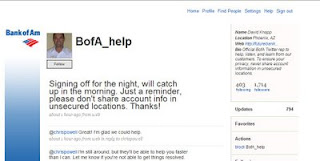
A good example of a bank that gets it is Bank of America. In January 2009, BofA launched its Twitter presence using the user ID BofA_help.


According to Holly Hastings on BofA's Future Banking Blog, "with the advent of social networking sites and blogs, companies have the opportunity to listen and learn from their consumers in ways that were not possible before. Companies can gain powerful knowledge on everything from product enhancements, customer service interactions and unresolved problems–but only if they listen. Social networking sites like Twitter enable that listening in real time." Other tweeters include UMB and Wachovia.

In a Februay 2009 ABA Banking Journal article, Pete Fields, Wachovia's senior vice-president and e-business director for corporate services and Web 2.0 said, “in August we started with Twitter because we wanted to develop a corporate competency in this type of social media. Our ‘followers’ have been very supportive about our presence on the platform. I believe they see it as a validation.” In the same article, Pamela K. Blase, senior vice-president and director of corporate communications, UMB Financial Corp., Kansas City, said that her bank started using Twitter to share information about the unfolding financial crisis.

According to the ABA Banking Journal, "the broader world of corporate Twitter users has also adopted the tool to stay in sync with their customers—and ease any daily tensions that are bound to erupt." As illustrated in the example above, a customer service strategy that utilizes Twitter (or a similar technology) can prevent every day issues from escalating into reputation damaging episodes. And the beauty of it is that Twitter communications are efficient at a maximum of 140 characters per tweet.

According to Carol Forsloff, despite the benefits of social media and Twitter, in particular, some businesses are afraid of having negative information posted - even if it is just 140 characters worth of griping. Ms. Forsloff, reminds businesses that criticism provides an opportunity to defend their business and explain their position. In the example above, the tweet allowed the bank to describe the issue not as a breakdown in the system but a scheduled outage for the purpose of maintaining the network.

So who should care about Twitter? Any bank that truly is interested in improving the customer experience. By leveraging this technology and incorporating it into an existing customer service infrastructure, banks can create considerable goodwill by demonstrating that they "get it" and are committed to dealing with customers on their terms.

Sunday, April 12, 2009

Should The Internet Be The New Resume?

Over the weekend I came across a very thought provoking article at Law.com titled Bank Nixes Use of Social Networking Sites in Hiring Process. This article, written by Jenny B. Davis, addressed a recent policy implemented by Amegy Bank of Texas, an $11 billion Houston-based bank.

The article speaks to the bank's decision to block all access to social media sites in an effort to prevent the bank's human resources personnel from accessing the personal profiles of job applicants. The article states that the bank's outside counsel recommended the policy in an effort to prevent unnecessary employment-based litigation. The article used the Pregnancy Discrimination Act as a key motivator, since it is plausible that an applicant's social media profile(s) may contain mention of a pending pregnancy or of other information that employers are not permitted to request. The danger is that upon discovery of such information, the bank's human resources personnel may be "perceived" as having acted on such information if an applicant is not hired. As such, if the bank's policy does not permit access to such sites, the bank has a strong defense against any such complaints.

While at first blush that bank's position may seem a bit severe and short sited, given that that almost 40% of employers have used Facebook and other social networking sites to gather information on job candidates and more than 80% of employers consider that negative information discovered when making hiring decisions, this was not an entirely bad decision. Further, during tough economic times people may be more apt to file frivolous compliants.

A related blog article at gNeil, titled Dangers of Using Social Networking Sites to Screen Applicants, stated that when a company uses the Internet to research job candidates and even current employees, there are some very important legal issues to keep in mind such as:

  • Invasion of privacy. Some social networking sites state specifically in their terms of service that is is illegal to use users’ profile information for commercial purposes.
  • State protected privacy. California and New York have laws preventing employers from interfering in employees’ private lives outside of the workplace.

  • Discrimination. Even if you stumbled across an applicant’s personal information unintentionally, it is unlawful to deny employment based on protected categories such as age, race or gender.

  • False information. It’s probably not surprising, but users on social networking sites don’t always post information that is entirely true. It’s best to rely on information that the applicant directly gives you.

  • Fair Credit Reporting Act (FCRA). If you’re using an outside agency to conduct background checks on job candidates, you must comply with the FCRA and receive the applicant’s consent before starting the background screening process.

So, while it has been said that the Internet is the new resume, banks should carefully craft thier background check procedures - especially those that utilize social networks. For example, use of LinkedIn would likely be acceptable since it is primarily used for professional purposes. However, other platforms such as Facebook and MySpace may be undesirable. While the use of these sites may provide helpful information relative to the character of the candidate, certain information may expose the bank to litigation.

According the the gNeil blog, "to avoid potential discrimination lawsuits, develop a uniform procedure for using social networking sites in the hiring process. Train everyone involved in the hiring process to treat every applicant consistently to avoid trouble and document each step you take. With the rate at which new technology emerges, it’s almost impossible for the law to keep up the pace. When you use social networking sites to research applicants, you may be taking uncertain legal risks with every search you make."

Amegy's CEO was quoted as saying, "good hiring decisions are among the top two or three decisions here, because it is where a lot of risks are managed." This is definitely true. And social media applications may help to reduce risk by identifying potential hazards. Unfortunately, human resource law is not Web 2.0 compliant and as such, taking advantage of these tools as part of the human resource process will require careful consideration, strong policies and procedures and an increased appetite for potential litigation.

Friday, April 10, 2009

Day One - Welcome to the Blog

Welcome to the first post of the Social Media and Banking blog. My name is Jesse Torres and I will be your tour guide as we discuss matters related to social media and banking.

As this is the first post, I figure a brief background is in order. I am a career banker with a major technology addiction. All through my career in banking (roughly 17 years), I have always favored technology as a way of improving the banking industry.

In my early days I was a bank examiner with the Treasury Department's Office of the Comptroller of the Currency and a senior consultant with KPMG Peat Marwick. In those roles I was always the tech guy who was called in when things went wrong in the field. It explains why I also hold CISA and CISSP certifications.

As I moved out of the field and into management, I continued to favor technology. Eventually, I came to oversee the IT departments of a couple banks I worked in and played a major role in technology acquisition and deployment.

Most recently I have played significant roles in marketing and developing brand identity for banks. This is where I became convinced that there are many benefits to be had in banking through social media.

In December 2008, I released an ebook called The Community Banker's Guide to Social Network Marketing. The Guide was released as a primer on social media and social networks targeted at community bankers. The goal was to raise bankers' awareness of the uses of social media. This project became quite a success, resulting in significant exposure for the Guide.

I established this blog after receiving considerable requests for an ongoing source of information related to banking and social media. I hope to address developments and stories to make the banking community better informed and more successful.

Thanks for joining me on this trip.

Jesse