Showing posts with label customer service. Show all posts

Tuesday, August 14, 2012

Community Outreach and Retail Banking


According to a recent article written by Alan Mattei of consultancy Novantas LLC, community outreach is fundamental to retail banking.  The problem banks face is determining how to best respond to the plethora of social platforms that include blogs, Facebook, Twitter, Pinterest, etc.


Mr. Mattei argues that social networking is forcing banks to think twice about the singular importance of branch banking.  As more time is spent online, shopping habits, including those related to bank products and services, have morphed and as such, banks must find ways to meet with customers at their new destinations – social media platforms.

As evidence of this transition, Mattei provides examples of two branchless financial services players that have begun to market products and services through social platforms: Ally Bank and American Express.

Ally’s online outreach includes a blog with self-help tips and expert advice; a continuing heavy stream of articles that are broadcast and posted on its Website; posts on Facebook; tweets; and infographics. Such activities have generated millions of Website visits and have become a driver in deposit account origination, according to Forresteor Research.


American Express launched its “Sync, Tweet, Save” program, which entices customers to sync their cards with their Twitter accounts. Under this arrangement, promotions from merchants and American Express are pushed to the customer via Twitter, with discount offers concurrently activated at the merchant point of sale.

Mattei states that today’s innovators in the use of social media are going beyond traditional banking’s defensive measures (e.g., reputation management).  Regardless, Mattei makes a point for walking before running by stating that “as a reasonable first step, institutions within the top 100 should establish an individual set of surveillance routines and contingency response plans for social media. This includes participating in conversational threads as appropriate; responding to customer service requests; diffusing negative events; and generally monitoring “the voice of the customer.” Much of this preparation remains to be done, although there are a few standout examples of banks with strong antennas in the virtual space.”  Here Mr. Mattei is spot on.  Mr. Mattei’s only error is that he has limited his advice to the top 100 when in fact every institution should follow this advice.

Mr. Mattei argues that social media and banking is about proactive involvement.  He argues that banks must learn to “proactively participate in the online dialogue, not just react in trying circumstances.”  The ultimate goal accord to Mattei is strengthening brand presence and building product awareness through:
  • Community Building
  • Two-Way Conversations
  • Content Threads
Mattei states that banks must begin incorporating social media into the overall marketing plan – despite the lack of maturity in the market.  Just like the online marketing scene created chaos for bankers yet bankers adapted, so too must bankers adapt to social media despite the chaos.  Mattei states that “institutions will have to start somewhere, just as they did when the Internet took off ten to fifteen years ago.”


Mattei attacks the ROI question head on when he states that “it is a mistake to begin using strict return on investment (ROI) calculations to evaluate social media initiatives right now.”  He compares today’s social ROI debate to that of online billpay of yesterday.  He points out that what years ago was a horrible ROI example, today has been an incredibly profitable service that creates serious retention.

For a second time in the article Mattei makes reference to the “majors” by stating that “for major banks, real traction with social media will require a dedicated team.”  While the advice he gives is sound, it applies to all banks.  Regardless, depending on the success and the leverage of social media within an organization, even smaller shops may want to consider community managers to run the day-to-day social operation.  Should they be outsiders or bank employees?  That is a conversation (debate) for another day.

Mattei goes on to address the use of social media for customer service.  He advises to start small and simple and figure out what works and what doesn’t.  He suggests using analytics to find the nuggets of gold that may result in an effective social effort.

Ultimately, Mattei states that “to mobilize for this new channel, executives must embrace the notion that building ‘social equity’ has long-term value for the institution. They then need to allocate the required resources, build the right teams, and craft a long-term strategy for transformation.”


I generally agree with Mattei.  I wish his focus would not have been so heavily slanted towards larger shops.  It is, after all, community banks that are best positioned to take advantage of the social media revolution.  Understandably, community banks are not likely going to spend the bucks on social like the top 100.  Regardless, it does not help the industry when the smaller players are ignored or left out of the "conversation."

Some useful links:  Social Media Risk Assessment Template

Monday, September 12, 2011

No Good Deed Goes Unpunished

A recent B & T article featured Australia's Commonwealth Bank.  The feature of the story was Andrew Lark, Commonwealth Bank's newly installed Chief Marketing Officer.  Mr. Lark highlighted Commonwealth Bank’s recent tie-up with Facebook Deals, offering people who opened a transaction account at the bank and liked the company on Facebook and checked in at a branch using Facebook Places, two free movie tickets every month for a year.  The strategy was successful from the point of view of new customer acquisition.  According to Commonwealth Bank's Facebook page it opened 2,200 new accounts.


While the campaign itself met its objective of establishing new accounts and growing its Facebook subscriber base, the campaign also went a long way upsetting existing customers who did not feel the love as they were not eligible for the free tickets.  Obviously, the point of the campaign was new accounts.  However, as detractors filed comment after comment on the Bank's Facebook page dedicated to the offer, Commonwealth Bank was no where to be found, resulting in greater and greater criticism.


Where Commonwealth Bank failed was in addressing the comments head on and explaining its strategy.  With social media you live by the sword and die by the sword.  In this case, the sword is transparency.  Commonwealth Bank's lack of transparency and participation let a great opportunity escape to "be real."  Instead of hiding from the comments the bank should have come out and explained the strategy so that its longstanding customers understood.  Along the way the bank would have picked up some helpful information to use relative to customer service and marketing.


Wednesday, September 30, 2009

Social Media Enabled Core Processors

I just read an article at SiliconRepublic.com that featured Tim Barker from Salesforce.com. Here's what Tim said relative to social media:

"...Firms need to get it out of their heads that its not just about marketing to these people but responding to their questions and providing services."


I think those of us that understand social media would wholeheartedly agree. But that is not the point of this post. As a banker I have worked on many core processor installations/conversions, including Metavante, Fiserv and Jack Henry. And that got me wondering how cool it would be to have a module built in within the core processor that would automatically scan Twitter or Facebook or any other social media platform, for key words that affect my bank. These comments can then be automatically routed to a customer service rep for response - directly from the core processor console. No third party apps, no cumbersome multiple platform searches, no problems.


It sounds like Salesforce.com is working down this road. It will then only be a matter of time before core processors start incorporating similar functionality. This can be very powerful in enabling banks on social media platforms. The conversation power would be tremendous. And because it is built into the core processor banks will more easily adopt social media as a core practice versus the occasional dabble which does no one any good.

Stay tuned!

Sunday, September 27, 2009

How Social Media Improves the WOM Effect

In The Financial Services Marketing Handbook (Bloomberg Press, 2004), Evelyn Ehrlich and Duke Fanelli address How End Users Select a Financial Services Provider.


According to Ehrlich and Fanelli:

"As with most services, the most common selection factor is word-of-mouth referral. This is not surprising, since most people don't have an objective way of judging the quality of financial advice, insurance claims handling, or other types of services. when seeking the services of a stockbroker, pension adviser, private bank, or hedge fund manager, both institutional and consumer buyers seek the advice of their peers."


If Ehrlich and Fanelli are correct regarding their assessment (and I believe they are), then bank boards and CEOs should ensure that their banks have considered the need for social media within their overall marketing plan. Why? Because of the effect that social media has had on word of mouth. The Community Banker's Guide to Social Network Marketing states the following:

"Researchers have observed that social media is affecting the way people communicate, make decisions, socialize, learn, entertain themselves, interact with each other and do their shopping. Accordingly, social media has caused a significant change in the market power of consumers, taking it away from product and service providers and giving it to consumers. The vast and growing knowledge base collected and maintained by social media applications has given consumers the power to make more informed decisions, forcing product and service providers, including banks, to deal in a more honest and open manner or lose the transaction to a competitor that does. And while social media presents serious challenges to businesses, it also provides opportunities to those that embrace the change and work within the new paradigm." "

Based on the power of social media and its ability to shape consumer behavior, every bank should consider and discuss the adoption of social media. While social media may not be right for every organization, the discussion should take place rather that just assuming for or against it without a meaningful discussion.

If buying decisions relative to bank products are highly dependent on word of mouth, and if word of mouth is a significant activity taking place on social networks, banks need to ensure that they, at a minimum are monitoring the conversations taking place that involve them. For example, in my last post I noted an actual case in which AT&T proactively monitored Twitter conversations to identify and resolve potential customer service issues. At a minimum, this same approach should be used by all banks.

As noted by Erlich and Fanelli, consumer buying decisions are shaped by word-of-mouth. By monitoring and responding to conversations taking place on social media platforms (social networks, blogs, etc.), the bank has the ability to demonstrate to the community that they are interested in truly serving their customers. But more importantly, these interactions go a long way in turning negative word-of-mouth into positive word-of-mouth, resulting in improved sales.

Thursday, April 16, 2009

Why Twitter Makes Bank Customer Service Better

By now most everyone has heard the word Twitter. In fact, if some one walked up to me and told me they had not heard the name I would call them a liar...to their face! Knowing the name and knowing what the name means, however, is an entirely different matter.

According to the Twitter Web site, Twitter is a privately funded startup with offices in San Francisco, CA. Twitter started as a side project in March of 2006 and has grown into a real-time short messaging service that works over multiple networks and devices.

Twitter is a tool that allows users to send short messages of no more than 140 characters to people that have signed on as "followers." A user signs up for a Twitter account and then asks others to become followers. Followers also may find a user without being specifically asked to follow. Once a user has a following, that user can send out short messages to broadcast anything and everything...so long as its no longer than 140 characters long! Messages can include anything from personal thoughts to Web sites.


What Good Are 140 Character-Long Messages

Most bankers' first response to Twitter is "so what!" Why should I, as a banker, care about Twitter? What is all the fuss about?

According to Matt Dickman, VP of Digital Marketing at Fleishman-Hillard, “Twitter is the ultimate customer service tool. It’s live, instantaneous, community driven, open, two-way and multi-way, unfiltered and predictive.“

Imagine this scenario...a bank customer is traveling in a foreign country and attempts to withdraw funds from an ATM. The time back home is the middle of the night and the ATM system is down for maintenance. The ATM message states that the transaction was denied - nothing else.

Scenario 1): The bank customer becomes infuriated that he could not withdraw funds. He eventually gets money out at a later time but is steamed his entire trip. Because this customer is of the Generation Y, the first thing he does, if he hasn't already done so, is let all of his acquantances know of the horrible service. The customer reaches out to his friends on Twitter, Facebook, MySpace and blogs. The result is a permanent record of his experience on the Internet for others to see. A digital black eye on the face of the bank. Once he finishes venting, he goes online, transfers all his money to another bank (which he opened online) and sends a message to close his account.

Scenario 2): The bank customer realizes that something is wrong since he has plenty of funds in his account. He gets on his iPod and sends a Twitter message (known as a "tweet") to the bank's call center. The assigned call center operator sees the message and sends back a quick message indicating that the ATM network is down for the next 20 minutes (you may have offline limits in place but probably don't want to broadcast these). The customer walks around the corner for a cup of coffee and returns 20 minutes later. Tada! Money. The customer enjoys the rest of his vacation and returns home. When asked about his trip he states that it was great. He mentions that along the way he had an ATM problem but that the bank's customer service department told him exactly what he needed to know when he sent a tweet. His friends are shocked that banks can actually be so responsive and customer focused. The Twitter tale gets passed on from one friend to another. Eventually, when it is time to open an account, some of the customer's friends decide to open an account at the bank because of the Twitter tale.

So who would go to all the trouble? Well, banks that "get it." That's who.

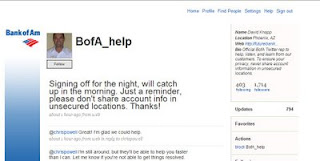
A good example of a bank that gets it is Bank of America. In January 2009, BofA launched its Twitter presence using the user ID BofA_help.


According to Holly Hastings on BofA's Future Banking Blog, "with the advent of social networking sites and blogs, companies have the opportunity to listen and learn from their consumers in ways that were not possible before. Companies can gain powerful knowledge on everything from product enhancements, customer service interactions and unresolved problems–but only if they listen. Social networking sites like Twitter enable that listening in real time." Other tweeters include UMB and Wachovia.

In a Februay 2009 ABA Banking Journal article, Pete Fields, Wachovia's senior vice-president and e-business director for corporate services and Web 2.0 said, “in August we started with Twitter because we wanted to develop a corporate competency in this type of social media. Our ‘followers’ have been very supportive about our presence on the platform. I believe they see it as a validation.” In the same article, Pamela K. Blase, senior vice-president and director of corporate communications, UMB Financial Corp., Kansas City, said that her bank started using Twitter to share information about the unfolding financial crisis.

According to the ABA Banking Journal, "the broader world of corporate Twitter users has also adopted the tool to stay in sync with their customers—and ease any daily tensions that are bound to erupt." As illustrated in the example above, a customer service strategy that utilizes Twitter (or a similar technology) can prevent every day issues from escalating into reputation damaging episodes. And the beauty of it is that Twitter communications are efficient at a maximum of 140 characters per tweet.

According to Carol Forsloff, despite the benefits of social media and Twitter, in particular, some businesses are afraid of having negative information posted - even if it is just 140 characters worth of griping. Ms. Forsloff, reminds businesses that criticism provides an opportunity to defend their business and explain their position. In the example above, the tweet allowed the bank to describe the issue not as a breakdown in the system but a scheduled outage for the purpose of maintaining the network.

So who should care about Twitter? Any bank that truly is interested in improving the customer experience. By leveraging this technology and incorporating it into an existing customer service infrastructure, banks can create considerable goodwill by demonstrating that they "get it" and are committed to dealing with customers on their terms.