Showing posts with label myspace. Show all posts

Thursday, October 1, 2009

This Isn't Your Son's Social Media

A few weeks ago I received an email from Dave Hamel, the Managing Director at ESW Partners, a Chicago-based advertising firm. Dave expressed surprise at how little banks are engaged in social media. Dave stated how important it is for banks to consider social media. He went on and further stated that "as a 56-year old bank customer, I also use social media. So they are missing me as well."


Later in the week I shared the conversation with a friend of mine who works for a former-brokerage-firm-turned-bank. This friend of mine stated that investment if social media is not a good use of money because social media is a kid's domain and kids don't have money. Unfortunately I did not have the time or the energy that night to get into an involved conversion/debate about the inaccuracy of his statement. I have to say that this guy IS a smart fellow whose intellect is highly regarded. So how could he make such a faux pas? Or did he?

If you visit Wikipedia for a definition of faux pas you learn that a faux pas is a violation of accepted social rules. The question this brought up was "is it socially acceptable to consider social media a kid's domain despite the contradictory research?" And is the faux pas on my part for believing that this isn't your son's (or daughter's) social media?

Fortunately, answering that question is beyond the scope of this post. However, I thought I would address the issue by providing some research. Given the expanding nature of social media, many many firms are conducting research on social media usage and demographics. I will put one source here. However, I encourage you to list other useful sources of research in the comments sections. I use Quantcast data for this post.

TWITTER


Looking at Quantcast data for October 2, 2009, as illustrated below, only a small cut of users are kids. Total Twitter users between the ages of 3 to 17 amount to a mere 10% of users. The next age group, the 18 to 34 year olds, amount to a more significant 43% of Twitter users. However, those 35 years old and older come in at 47% of all users!


FACEBOOK


Now let's look at Facebook. While the numbers are not as strong from the "old guy" (gal) perspective, they still show that a significant percentage (33%) of 35+ year olds use Facebook. That is one-third of all users and more than the 3 to 17 year old group!


LINKEDIN


Now if you really want to skew things, let's look at LinkedIn. Anyone familiar with this social media platform knows that it obviously favors the 35+ year olds based upon its focus on professionals. No faux pas here. The 35+ year old group represents 76% of users. That is tremendous.


MYSPACE


But no analysis would be complete without including MySpace (at least until it dies a natural death). Clearly, compared to the other sites reviewed, MySpace is most representive of the incorrectly held believe that social media is a kids space. Perhaps the reason for this is because MySpace was an early MAJOR entrant in social media. Of course, if you follow MySpace you realize that without some major changes this platform will become a small niche platform or fall off the scene altogether. However, despite its emphasis on youth (28% 3 to 17 year olds and 46% 18 to 34 year olds) the platform has a decent percentage of older users at 26% of total users.


Of course I left out many other platforms. But my point was not to provide a comprehensive survey of the space. The point was to illustrate that social media use is not dominated by the young. Older consumers with the need for checking, savings, mortgages, investments and other grown up financial products and services are very well represented on social media platforms. Therefore, if you are dismissing social media as a kid's game you are risking not only losing the game but a significant amount of business to your competitor that realizes that the faux pas is not on him but on you.

Sunday, May 10, 2009

Duality of Social Media in Banking

With banks working double time to squeeze value out from every last penny, many bankers are taking a closer look at social media and the value it can bring to an organization.

For about a year and a half references have been made increasingly regarding MySpace and Facebook and how businesses can appeal to the masses that visit these sites. Then a couple weeks ago it all broke loose when Ashton Kutcher battled CNN for the first to hold one million followers on Twitter. And then it happened, the tipping point, the day everything changed. The day Twitter became a household word.

Since that day I have been approached by banker acquaintances asking me how they can use Twitter to make them heroes. And in these discussions I found the duality of social media.

The banking industry is one of a handful of industries that is overly regulated and becoming more so every day (thanks TARP!). While bankers see the benefits of using Twitter and social media, they often find it very difficult to get past the associated risks. On the other hand, bankers make their living dealing in risk. As such, it would appear to me that banking is one of only a few industries that is well suited to incorporate the use of social media, warts and all.

So to my banker friends I say, get over it and do what you do best - assess your risks. The first step in any new bank product/service launch is the risk assessment. Risks can originate from the statutory liability and regulatory penalties that are specified by law, or from reputational damage that could result from publicity of noncompliance (see Social Media and Bank Compliance Requirements). Once you get your arms around the risks and feel warm and fuzzy about dipping your ties, get to it.

Of course, as with any implementation, you must have a plan that is well thought our and clearly defined. This involves doing your homework. Speak to experienced social media practitioners by researching them on the Web or meeting them at social media conferences, see what the competition is doing, see what other industries are doing, read The Community Banker's Guide to Social Network Marketing (disclosure: I wrote this free ebook), get the green light from the right people and put your team together.

Unfortunately, today, everyone is still largely feeling their way around. The use of social media in a commercial setting has only just begun. However, there is a large global community that actively supports this effort. So, while the model has not been entirely proven, the successes to date, the support network and the masses of consumers taking to social media should make dipping your toes at least something to consider.

Anyone up for a swim?!

Saturday, May 9, 2009

Banking is Our Business, and We Think Our Business Needs to Be Wherever People are Talking About Banking

"Banking is our business, and we think our business needs to be wherever people are talking about banking."

The quote above was provided by Peter Aceto, CEO of ING Direct Canada in an interview with Bank Technology News Magazine. Mr. Aceto, an active tweeter, expresses an opinion held by many "enlightened" bankers. But banker beware: if you build it, they may not come.

Rebecca Sausner says "just because there are millions of people at a concert doesn't mean they want to see a banker take the stage." This is a great point. However, I would counter her by saying that banks should have some form of presence for the ocassion in which a client or potential clients needs to reach out. It is during those opportunities that banks will earn the points that put them over the top in the hearts and minds of consumers.

I am a tremendous fan of social media and the many benefits it brings to the banking environment. However, I recognize the many nuances that need to be considered in developing and implementing a social media plan. I agree that a bank's place within social media is not in-your-face. In fact, that is probably the last thing you want to do. Having said that, there are many ways in which banks may leverage social media while playing a role in the background and staying prepared to pounce on opportunities as they come up.

A good example is Bank of America's social network for small business operators. Bank of America has created a space on its dime that draws customers and non-customers together to share ideas and leverage from each other. As conversations take place, BofA is prepared to jump in to provide answers. Also, BofA is along the way collecting information that will assist in the development or improvement of new products and services. So, going back to Rebecca's analogy, while BofA may have built the stage, they are not on the stage but are instead backstage prepared to deal with any questions that may pop up as well as out in the stands listening to the crowds reactions.

Rebecca also made a point about the current financial viability of social media platforms such as Twitter, Facebook, et al, and whether their inability to create income is worthy of steering clear. My immediate response is "so what!" Applications like Facebook and Twitter are drawing in batches of people by the millions. Banks should do what they can to leverage their brand. However, banks should also be sure that their commitments take into consideration the fact that a specific platform or the social network/media industry as a whole may dramatically change over time. But the fact the Twitter may be here today and gone next year should not keep me away from taking advantage of the asset (e.g., people). I just need to make sure that my return in consistent with the investment made.

I think Rebeccas was spot on when she said, "the larger point is that understanding your customers is key. If your customers are addicted to Facebook, texting, tweeting, or LinkedIn groups, you should at least have first-hand knowledge of how and why. " That's pretty much it in a nutshell. Know your customers, know what makes them tick and you'll be able to appeal to them and develop products and services that they will be unable to live without.

For more information on the nuances of social media, download a free copy of The Community Banker's Guide to Social Network Marketing.

Thursday, April 16, 2009

Why Twitter Makes Bank Customer Service Better

By now most everyone has heard the word Twitter. In fact, if some one walked up to me and told me they had not heard the name I would call them a liar...to their face! Knowing the name and knowing what the name means, however, is an entirely different matter.

According to the Twitter Web site, Twitter is a privately funded startup with offices in San Francisco, CA. Twitter started as a side project in March of 2006 and has grown into a real-time short messaging service that works over multiple networks and devices.

Twitter is a tool that allows users to send short messages of no more than 140 characters to people that have signed on as "followers." A user signs up for a Twitter account and then asks others to become followers. Followers also may find a user without being specifically asked to follow. Once a user has a following, that user can send out short messages to broadcast anything and everything...so long as its no longer than 140 characters long! Messages can include anything from personal thoughts to Web sites.


What Good Are 140 Character-Long Messages

Most bankers' first response to Twitter is "so what!" Why should I, as a banker, care about Twitter? What is all the fuss about?

According to Matt Dickman, VP of Digital Marketing at Fleishman-Hillard, “Twitter is the ultimate customer service tool. It’s live, instantaneous, community driven, open, two-way and multi-way, unfiltered and predictive.“

Imagine this scenario...a bank customer is traveling in a foreign country and attempts to withdraw funds from an ATM. The time back home is the middle of the night and the ATM system is down for maintenance. The ATM message states that the transaction was denied - nothing else.

Scenario 1): The bank customer becomes infuriated that he could not withdraw funds. He eventually gets money out at a later time but is steamed his entire trip. Because this customer is of the Generation Y, the first thing he does, if he hasn't already done so, is let all of his acquantances know of the horrible service. The customer reaches out to his friends on Twitter, Facebook, MySpace and blogs. The result is a permanent record of his experience on the Internet for others to see. A digital black eye on the face of the bank. Once he finishes venting, he goes online, transfers all his money to another bank (which he opened online) and sends a message to close his account.

Scenario 2): The bank customer realizes that something is wrong since he has plenty of funds in his account. He gets on his iPod and sends a Twitter message (known as a "tweet") to the bank's call center. The assigned call center operator sees the message and sends back a quick message indicating that the ATM network is down for the next 20 minutes (you may have offline limits in place but probably don't want to broadcast these). The customer walks around the corner for a cup of coffee and returns 20 minutes later. Tada! Money. The customer enjoys the rest of his vacation and returns home. When asked about his trip he states that it was great. He mentions that along the way he had an ATM problem but that the bank's customer service department told him exactly what he needed to know when he sent a tweet. His friends are shocked that banks can actually be so responsive and customer focused. The Twitter tale gets passed on from one friend to another. Eventually, when it is time to open an account, some of the customer's friends decide to open an account at the bank because of the Twitter tale.

So who would go to all the trouble? Well, banks that "get it." That's who.

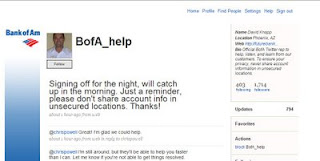
A good example of a bank that gets it is Bank of America. In January 2009, BofA launched its Twitter presence using the user ID BofA_help.


According to Holly Hastings on BofA's Future Banking Blog, "with the advent of social networking sites and blogs, companies have the opportunity to listen and learn from their consumers in ways that were not possible before. Companies can gain powerful knowledge on everything from product enhancements, customer service interactions and unresolved problems–but only if they listen. Social networking sites like Twitter enable that listening in real time." Other tweeters include UMB and Wachovia.

In a Februay 2009 ABA Banking Journal article, Pete Fields, Wachovia's senior vice-president and e-business director for corporate services and Web 2.0 said, “in August we started with Twitter because we wanted to develop a corporate competency in this type of social media. Our ‘followers’ have been very supportive about our presence on the platform. I believe they see it as a validation.” In the same article, Pamela K. Blase, senior vice-president and director of corporate communications, UMB Financial Corp., Kansas City, said that her bank started using Twitter to share information about the unfolding financial crisis.

According to the ABA Banking Journal, "the broader world of corporate Twitter users has also adopted the tool to stay in sync with their customers—and ease any daily tensions that are bound to erupt." As illustrated in the example above, a customer service strategy that utilizes Twitter (or a similar technology) can prevent every day issues from escalating into reputation damaging episodes. And the beauty of it is that Twitter communications are efficient at a maximum of 140 characters per tweet.

According to Carol Forsloff, despite the benefits of social media and Twitter, in particular, some businesses are afraid of having negative information posted - even if it is just 140 characters worth of griping. Ms. Forsloff, reminds businesses that criticism provides an opportunity to defend their business and explain their position. In the example above, the tweet allowed the bank to describe the issue not as a breakdown in the system but a scheduled outage for the purpose of maintaining the network.

So who should care about Twitter? Any bank that truly is interested in improving the customer experience. By leveraging this technology and incorporating it into an existing customer service infrastructure, banks can create considerable goodwill by demonstrating that they "get it" and are committed to dealing with customers on their terms.