Showing posts with label twitter. Show all posts

Tuesday, August 14, 2012

Community Outreach and Retail Banking


According to a recent article written by Alan Mattei of consultancy Novantas LLC, community outreach is fundamental to retail banking.  The problem banks face is determining how to best respond to the plethora of social platforms that include blogs, Facebook, Twitter, Pinterest, etc.


Mr. Mattei argues that social networking is forcing banks to think twice about the singular importance of branch banking.  As more time is spent online, shopping habits, including those related to bank products and services, have morphed and as such, banks must find ways to meet with customers at their new destinations – social media platforms.

As evidence of this transition, Mattei provides examples of two branchless financial services players that have begun to market products and services through social platforms: Ally Bank and American Express.

Ally’s online outreach includes a blog with self-help tips and expert advice; a continuing heavy stream of articles that are broadcast and posted on its Website; posts on Facebook; tweets; and infographics. Such activities have generated millions of Website visits and have become a driver in deposit account origination, according to Forresteor Research.


American Express launched its “Sync, Tweet, Save” program, which entices customers to sync their cards with their Twitter accounts. Under this arrangement, promotions from merchants and American Express are pushed to the customer via Twitter, with discount offers concurrently activated at the merchant point of sale.

Mattei states that today’s innovators in the use of social media are going beyond traditional banking’s defensive measures (e.g., reputation management).  Regardless, Mattei makes a point for walking before running by stating that “as a reasonable first step, institutions within the top 100 should establish an individual set of surveillance routines and contingency response plans for social media. This includes participating in conversational threads as appropriate; responding to customer service requests; diffusing negative events; and generally monitoring “the voice of the customer.” Much of this preparation remains to be done, although there are a few standout examples of banks with strong antennas in the virtual space.”  Here Mr. Mattei is spot on.  Mr. Mattei’s only error is that he has limited his advice to the top 100 when in fact every institution should follow this advice.

Mr. Mattei argues that social media and banking is about proactive involvement.  He argues that banks must learn to “proactively participate in the online dialogue, not just react in trying circumstances.”  The ultimate goal accord to Mattei is strengthening brand presence and building product awareness through:
  • Community Building
  • Two-Way Conversations
  • Content Threads
Mattei states that banks must begin incorporating social media into the overall marketing plan – despite the lack of maturity in the market.  Just like the online marketing scene created chaos for bankers yet bankers adapted, so too must bankers adapt to social media despite the chaos.  Mattei states that “institutions will have to start somewhere, just as they did when the Internet took off ten to fifteen years ago.”


Mattei attacks the ROI question head on when he states that “it is a mistake to begin using strict return on investment (ROI) calculations to evaluate social media initiatives right now.”  He compares today’s social ROI debate to that of online billpay of yesterday.  He points out that what years ago was a horrible ROI example, today has been an incredibly profitable service that creates serious retention.

For a second time in the article Mattei makes reference to the “majors” by stating that “for major banks, real traction with social media will require a dedicated team.”  While the advice he gives is sound, it applies to all banks.  Regardless, depending on the success and the leverage of social media within an organization, even smaller shops may want to consider community managers to run the day-to-day social operation.  Should they be outsiders or bank employees?  That is a conversation (debate) for another day.

Mattei goes on to address the use of social media for customer service.  He advises to start small and simple and figure out what works and what doesn’t.  He suggests using analytics to find the nuggets of gold that may result in an effective social effort.

Ultimately, Mattei states that “to mobilize for this new channel, executives must embrace the notion that building ‘social equity’ has long-term value for the institution. They then need to allocate the required resources, build the right teams, and craft a long-term strategy for transformation.”


I generally agree with Mattei.  I wish his focus would not have been so heavily slanted towards larger shops.  It is, after all, community banks that are best positioned to take advantage of the social media revolution.  Understandably, community banks are not likely going to spend the bucks on social like the top 100.  Regardless, it does not help the industry when the smaller players are ignored or left out of the "conversation."

Some useful links:  Social Media Risk Assessment Template

Tuesday, December 1, 2009

Yes, Press Releases Are Now Part of Social Media and VERY Viral

About a week ago, after issuing a press release about my company's use of social media, I saw a tweet come up from someone questioning the use of a press release to promote Web 2.0. What I got from the tweet's 140 characters was essentially doubt about the use of press releases (traditional old school technique) in promoting use of Web 2.0. The tweet said something along the lines of "Why would a company that is rolling out social media use a press release. Social media is about being viral. Press releases are not viral."

This post has been created to make you aware that, yes, press releases ARE social media and ARE definitely viral. I'm not a publicist by schooling but I have had years of experience using press releases in the pre- and post-Web 2.0 world. Something I noticed about a year ago was how the press release outlets, including the majors such as BusinessWire, started Web 2.0-enabling their releases. The following is an example of the social media functionality added to press releases to enable their VIRAL distribution.


As you can see under the "Sharing" section on the left side of the page, the press release outlet (in this case BusinessWire) added a series of common social media platforms with which this press release could very easily be shared. This is only one outlet, but I've seen most outlets incorporate this "viral accelerator" to their pages.

As a result of a recent press release, I achieved immediate and broad distribution on Twitter illustrated by the sampling below:


As you can see, just on Twitter alone there were nearly 100 retweets of the press release. Multiply that number by the number of followers that read each retweet and you can see how a traditional press release can achieve viral distribution.

Now consider how these traditional press releases are distributed to hundreds of online media outlets by the wire services, resulting in greater viral potential. Below is a snapshot of a small number of the media outlets that received the press release from the wire service and began serving up copies of the press release - again, each with a similar "sharing" feature.


Now, keep in mind that simply having a "viral accelerator" does not mean a press relaese will achieve viral results. The material has to possess certain qualities. Press releases in of themselves are not great for creating viral buzz. But press releases tied to good viral content will do the job. I recommend reading the chapter of Viral Marketing in The Community Banker's Guide to Social Network Marketing for more details.

In any case, to answer the question posed by the tweet mentioned above, the fact that press releases have Web 2.0 funtionality means that, YES, press releases ARE about viral distribution.

Sunday, October 18, 2009

Why Willie Sutton Would Not Survive Long With Web 2.0

A couple weeks ago I wrote a piece called What Bankers and Willie Sutton Have in Common. If you recall that post you'll remember who Willie Sutton was...a famous bank robber whose career spanned decades.


The point of that post was not to discuss bank robbery. The point was to make the reader aware of the obvious...people are using social media at an increasing rate and banks should consider whether it makes sense for them.

Like I said, the point of THAT post was not to talk about bank robbery. But that was then and this is now. So today, let's talk about bank robbery.

On October 18, 2009, Seth Liss of the Sun Sentinel newspaper wrote an article called "Social Media the New Crime-Fighter." This article discussed how social media is currently being used by private citizens as well as law enforcement to track down criminals. Through YouTube, Facebook and Twitter, people are creating their own version of America's Most Wanted, the popular syndicated television program.

This got me to thinking...again. If law enforcement can post photos and videos on Twitpic, YouTube, etc., shouldn't banks use the same technology in the event of a robbery? While some thought needs to be given to how it is publicized and where it is published, social media can be an effective way to speed up the discovery process in the case of a bank robbery...or any crime, for that matter.

Now, I say some thought needs to be given to the manner of disclosure because no banker would want to general public to get the impression that the bank is Robbery Central and subsequently, unsafe. However, handled properly social media can be an effective tool to closing bank robbery cases and simultaneously act as a preventive tool since no one wants their friends to spot them with women's hosiery over their head (not that there's anything wrong with that!).

I must admit that I haven't given this too much thought and I would probably want to consult a security expert (any out there?) to provide some pros and cons in terms of disclosure. But at a very basic level it seems like something that could work and become incorporated into a bank's overall social media strategy as well as its risk management strategy. Tie a decent bounty to tips leading to an arrest and in this economy you'll have some pretty good success.

Saturday, October 10, 2009

What Bankers and Willie Sutton Have in Common in 2009

If you've been a banker for any extent of time chances are you've heard his name - or at least his quote. Willie Sutton was a career bank robber who held up over 100 banks from the 1920s to the 1950s (final arrest in 1952). As the story goes, after being arrested Willie was asked why he did it..."because that's where the money is."


So what does Willie Sutton have to do with social media?

On September 21, 2009, comScore Media Matrix released its rankings of the top 50 U.S. Web properties for August 2009. According to comScore, Facebook came in at 5th place with 92.2 million unique visitors - a five percent increase from July 2009. Twitter came in at 46th place with 20.8 million unique visitors.

So, let me ask it again...what does Willie Sutton have to do with social media? If Willie were alive today, he'd probably say, "because that's where the money is."

That's right. The money. Banks, and businesses in general, need to consider how to best utilize social media to develop their businesses - from customer service to reputation risk management to sales and marketing. And by doing all these things well, banks will find a route to new found treasure.

But, of course, social media is NOT the same as Web or email marketing. Social media is much more complicated and brings with it a whole new set of nuances that set it apart from traditional online marketing. In a nutshell, the nuances involve honest, transparent and ongoing conversations with the "community." This post does not cover those nuances in detail but is intended to get bankers thinking about the potential for the use of social media; to get bankers to think about where to find the money (without having to hold up a competitor!). I recommend the ebook Community Banker's Guide to Social Network Marketing for a detailed description of the nuances.

I recently read a post by Richard Pentin where he stated that the honeymoon over social media is over. While I respect Mr. Pentin's view, from the banking industries point of view, he could not be further from the truth. As a banker it hurts me to say that we tend to be far behind the innovation curve. So while the rest of the world has been neck deep in social media over the past two years, bankers are just now starting to get their arms around it. As such, from a banker's perspective, the honeymoon is just beginning. And with bankers' current and potential customers increasing jumping onto Facebook and Twitter and other social platforms at increasing rates, bankers need to figure out how to continue to meet the demands of the evolving consumer as well as how to use those evolving technologies to secure additional business.

What is another reason bankers consider social media? Well, to quote another controversial historical figure, former President Bill Clinton, "It's The Economy Stupid." As the economy continues to struggle, consumers have become more critical of the banking industry. With TARP, AIG, Lehman Bros., et al, bankers have taken a hit from a reputational perspective. Social media can assist in healing those wounds through the honest and transparent approach required by social media.

I could go on and on but I really think that the next step requires a thorough reading of the Community Banker's Guide to Social Network Marketing. Then we can come back and fill in the gaps.

Thursday, October 1, 2009

This Isn't Your Son's Social Media

A few weeks ago I received an email from Dave Hamel, the Managing Director at ESW Partners, a Chicago-based advertising firm. Dave expressed surprise at how little banks are engaged in social media. Dave stated how important it is for banks to consider social media. He went on and further stated that "as a 56-year old bank customer, I also use social media. So they are missing me as well."


Later in the week I shared the conversation with a friend of mine who works for a former-brokerage-firm-turned-bank. This friend of mine stated that investment if social media is not a good use of money because social media is a kid's domain and kids don't have money. Unfortunately I did not have the time or the energy that night to get into an involved conversion/debate about the inaccuracy of his statement. I have to say that this guy IS a smart fellow whose intellect is highly regarded. So how could he make such a faux pas? Or did he?

If you visit Wikipedia for a definition of faux pas you learn that a faux pas is a violation of accepted social rules. The question this brought up was "is it socially acceptable to consider social media a kid's domain despite the contradictory research?" And is the faux pas on my part for believing that this isn't your son's (or daughter's) social media?

Fortunately, answering that question is beyond the scope of this post. However, I thought I would address the issue by providing some research. Given the expanding nature of social media, many many firms are conducting research on social media usage and demographics. I will put one source here. However, I encourage you to list other useful sources of research in the comments sections. I use Quantcast data for this post.

TWITTER


Looking at Quantcast data for October 2, 2009, as illustrated below, only a small cut of users are kids. Total Twitter users between the ages of 3 to 17 amount to a mere 10% of users. The next age group, the 18 to 34 year olds, amount to a more significant 43% of Twitter users. However, those 35 years old and older come in at 47% of all users!


FACEBOOK


Now let's look at Facebook. While the numbers are not as strong from the "old guy" (gal) perspective, they still show that a significant percentage (33%) of 35+ year olds use Facebook. That is one-third of all users and more than the 3 to 17 year old group!


LINKEDIN


Now if you really want to skew things, let's look at LinkedIn. Anyone familiar with this social media platform knows that it obviously favors the 35+ year olds based upon its focus on professionals. No faux pas here. The 35+ year old group represents 76% of users. That is tremendous.


MYSPACE


But no analysis would be complete without including MySpace (at least until it dies a natural death). Clearly, compared to the other sites reviewed, MySpace is most representive of the incorrectly held believe that social media is a kids space. Perhaps the reason for this is because MySpace was an early MAJOR entrant in social media. Of course, if you follow MySpace you realize that without some major changes this platform will become a small niche platform or fall off the scene altogether. However, despite its emphasis on youth (28% 3 to 17 year olds and 46% 18 to 34 year olds) the platform has a decent percentage of older users at 26% of total users.


Of course I left out many other platforms. But my point was not to provide a comprehensive survey of the space. The point was to illustrate that social media use is not dominated by the young. Older consumers with the need for checking, savings, mortgages, investments and other grown up financial products and services are very well represented on social media platforms. Therefore, if you are dismissing social media as a kid's game you are risking not only losing the game but a significant amount of business to your competitor that realizes that the faux pas is not on him but on you.

Wednesday, September 30, 2009

Social Media Enabled Core Processors

I just read an article at SiliconRepublic.com that featured Tim Barker from Salesforce.com. Here's what Tim said relative to social media:

"...Firms need to get it out of their heads that its not just about marketing to these people but responding to their questions and providing services."


I think those of us that understand social media would wholeheartedly agree. But that is not the point of this post. As a banker I have worked on many core processor installations/conversions, including Metavante, Fiserv and Jack Henry. And that got me wondering how cool it would be to have a module built in within the core processor that would automatically scan Twitter or Facebook or any other social media platform, for key words that affect my bank. These comments can then be automatically routed to a customer service rep for response - directly from the core processor console. No third party apps, no cumbersome multiple platform searches, no problems.


It sounds like Salesforce.com is working down this road. It will then only be a matter of time before core processors start incorporating similar functionality. This can be very powerful in enabling banks on social media platforms. The conversation power would be tremendous. And because it is built into the core processor banks will more easily adopt social media as a core practice versus the occasional dabble which does no one any good.

Stay tuned!

Sunday, September 27, 2009

How Social Media Improves the WOM Effect

In The Financial Services Marketing Handbook (Bloomberg Press, 2004), Evelyn Ehrlich and Duke Fanelli address How End Users Select a Financial Services Provider.


According to Ehrlich and Fanelli:

"As with most services, the most common selection factor is word-of-mouth referral. This is not surprising, since most people don't have an objective way of judging the quality of financial advice, insurance claims handling, or other types of services. when seeking the services of a stockbroker, pension adviser, private bank, or hedge fund manager, both institutional and consumer buyers seek the advice of their peers."


If Ehrlich and Fanelli are correct regarding their assessment (and I believe they are), then bank boards and CEOs should ensure that their banks have considered the need for social media within their overall marketing plan. Why? Because of the effect that social media has had on word of mouth. The Community Banker's Guide to Social Network Marketing states the following:

"Researchers have observed that social media is affecting the way people communicate, make decisions, socialize, learn, entertain themselves, interact with each other and do their shopping. Accordingly, social media has caused a significant change in the market power of consumers, taking it away from product and service providers and giving it to consumers. The vast and growing knowledge base collected and maintained by social media applications has given consumers the power to make more informed decisions, forcing product and service providers, including banks, to deal in a more honest and open manner or lose the transaction to a competitor that does. And while social media presents serious challenges to businesses, it also provides opportunities to those that embrace the change and work within the new paradigm." "

Based on the power of social media and its ability to shape consumer behavior, every bank should consider and discuss the adoption of social media. While social media may not be right for every organization, the discussion should take place rather that just assuming for or against it without a meaningful discussion.

If buying decisions relative to bank products are highly dependent on word of mouth, and if word of mouth is a significant activity taking place on social networks, banks need to ensure that they, at a minimum are monitoring the conversations taking place that involve them. For example, in my last post I noted an actual case in which AT&T proactively monitored Twitter conversations to identify and resolve potential customer service issues. At a minimum, this same approach should be used by all banks.

As noted by Erlich and Fanelli, consumer buying decisions are shaped by word-of-mouth. By monitoring and responding to conversations taking place on social media platforms (social networks, blogs, etc.), the bank has the ability to demonstrate to the community that they are interested in truly serving their customers. But more importantly, these interactions go a long way in turning negative word-of-mouth into positive word-of-mouth, resulting in improved sales.

Sunday, May 10, 2009

Duality of Social Media in Banking

With banks working double time to squeeze value out from every last penny, many bankers are taking a closer look at social media and the value it can bring to an organization.

For about a year and a half references have been made increasingly regarding MySpace and Facebook and how businesses can appeal to the masses that visit these sites. Then a couple weeks ago it all broke loose when Ashton Kutcher battled CNN for the first to hold one million followers on Twitter. And then it happened, the tipping point, the day everything changed. The day Twitter became a household word.

Since that day I have been approached by banker acquaintances asking me how they can use Twitter to make them heroes. And in these discussions I found the duality of social media.

The banking industry is one of a handful of industries that is overly regulated and becoming more so every day (thanks TARP!). While bankers see the benefits of using Twitter and social media, they often find it very difficult to get past the associated risks. On the other hand, bankers make their living dealing in risk. As such, it would appear to me that banking is one of only a few industries that is well suited to incorporate the use of social media, warts and all.

So to my banker friends I say, get over it and do what you do best - assess your risks. The first step in any new bank product/service launch is the risk assessment. Risks can originate from the statutory liability and regulatory penalties that are specified by law, or from reputational damage that could result from publicity of noncompliance (see Social Media and Bank Compliance Requirements). Once you get your arms around the risks and feel warm and fuzzy about dipping your ties, get to it.

Of course, as with any implementation, you must have a plan that is well thought our and clearly defined. This involves doing your homework. Speak to experienced social media practitioners by researching them on the Web or meeting them at social media conferences, see what the competition is doing, see what other industries are doing, read The Community Banker's Guide to Social Network Marketing (disclosure: I wrote this free ebook), get the green light from the right people and put your team together.

Unfortunately, today, everyone is still largely feeling their way around. The use of social media in a commercial setting has only just begun. However, there is a large global community that actively supports this effort. So, while the model has not been entirely proven, the successes to date, the support network and the masses of consumers taking to social media should make dipping your toes at least something to consider.

Anyone up for a swim?!

Saturday, May 9, 2009

Banking is Our Business, and We Think Our Business Needs to Be Wherever People are Talking About Banking

"Banking is our business, and we think our business needs to be wherever people are talking about banking."

The quote above was provided by Peter Aceto, CEO of ING Direct Canada in an interview with Bank Technology News Magazine. Mr. Aceto, an active tweeter, expresses an opinion held by many "enlightened" bankers. But banker beware: if you build it, they may not come.

Rebecca Sausner says "just because there are millions of people at a concert doesn't mean they want to see a banker take the stage." This is a great point. However, I would counter her by saying that banks should have some form of presence for the ocassion in which a client or potential clients needs to reach out. It is during those opportunities that banks will earn the points that put them over the top in the hearts and minds of consumers.

I am a tremendous fan of social media and the many benefits it brings to the banking environment. However, I recognize the many nuances that need to be considered in developing and implementing a social media plan. I agree that a bank's place within social media is not in-your-face. In fact, that is probably the last thing you want to do. Having said that, there are many ways in which banks may leverage social media while playing a role in the background and staying prepared to pounce on opportunities as they come up.

A good example is Bank of America's social network for small business operators. Bank of America has created a space on its dime that draws customers and non-customers together to share ideas and leverage from each other. As conversations take place, BofA is prepared to jump in to provide answers. Also, BofA is along the way collecting information that will assist in the development or improvement of new products and services. So, going back to Rebecca's analogy, while BofA may have built the stage, they are not on the stage but are instead backstage prepared to deal with any questions that may pop up as well as out in the stands listening to the crowds reactions.

Rebecca also made a point about the current financial viability of social media platforms such as Twitter, Facebook, et al, and whether their inability to create income is worthy of steering clear. My immediate response is "so what!" Applications like Facebook and Twitter are drawing in batches of people by the millions. Banks should do what they can to leverage their brand. However, banks should also be sure that their commitments take into consideration the fact that a specific platform or the social network/media industry as a whole may dramatically change over time. But the fact the Twitter may be here today and gone next year should not keep me away from taking advantage of the asset (e.g., people). I just need to make sure that my return in consistent with the investment made.

I think Rebeccas was spot on when she said, "the larger point is that understanding your customers is key. If your customers are addicted to Facebook, texting, tweeting, or LinkedIn groups, you should at least have first-hand knowledge of how and why. " That's pretty much it in a nutshell. Know your customers, know what makes them tick and you'll be able to appeal to them and develop products and services that they will be unable to live without.

For more information on the nuances of social media, download a free copy of The Community Banker's Guide to Social Network Marketing.

Thursday, April 16, 2009

Why Twitter Makes Bank Customer Service Better

By now most everyone has heard the word Twitter. In fact, if some one walked up to me and told me they had not heard the name I would call them a liar...to their face! Knowing the name and knowing what the name means, however, is an entirely different matter.

According to the Twitter Web site, Twitter is a privately funded startup with offices in San Francisco, CA. Twitter started as a side project in March of 2006 and has grown into a real-time short messaging service that works over multiple networks and devices.

Twitter is a tool that allows users to send short messages of no more than 140 characters to people that have signed on as "followers." A user signs up for a Twitter account and then asks others to become followers. Followers also may find a user without being specifically asked to follow. Once a user has a following, that user can send out short messages to broadcast anything and everything...so long as its no longer than 140 characters long! Messages can include anything from personal thoughts to Web sites.


What Good Are 140 Character-Long Messages

Most bankers' first response to Twitter is "so what!" Why should I, as a banker, care about Twitter? What is all the fuss about?

According to Matt Dickman, VP of Digital Marketing at Fleishman-Hillard, “Twitter is the ultimate customer service tool. It’s live, instantaneous, community driven, open, two-way and multi-way, unfiltered and predictive.“

Imagine this scenario...a bank customer is traveling in a foreign country and attempts to withdraw funds from an ATM. The time back home is the middle of the night and the ATM system is down for maintenance. The ATM message states that the transaction was denied - nothing else.

Scenario 1): The bank customer becomes infuriated that he could not withdraw funds. He eventually gets money out at a later time but is steamed his entire trip. Because this customer is of the Generation Y, the first thing he does, if he hasn't already done so, is let all of his acquantances know of the horrible service. The customer reaches out to his friends on Twitter, Facebook, MySpace and blogs. The result is a permanent record of his experience on the Internet for others to see. A digital black eye on the face of the bank. Once he finishes venting, he goes online, transfers all his money to another bank (which he opened online) and sends a message to close his account.

Scenario 2): The bank customer realizes that something is wrong since he has plenty of funds in his account. He gets on his iPod and sends a Twitter message (known as a "tweet") to the bank's call center. The assigned call center operator sees the message and sends back a quick message indicating that the ATM network is down for the next 20 minutes (you may have offline limits in place but probably don't want to broadcast these). The customer walks around the corner for a cup of coffee and returns 20 minutes later. Tada! Money. The customer enjoys the rest of his vacation and returns home. When asked about his trip he states that it was great. He mentions that along the way he had an ATM problem but that the bank's customer service department told him exactly what he needed to know when he sent a tweet. His friends are shocked that banks can actually be so responsive and customer focused. The Twitter tale gets passed on from one friend to another. Eventually, when it is time to open an account, some of the customer's friends decide to open an account at the bank because of the Twitter tale.

So who would go to all the trouble? Well, banks that "get it." That's who.

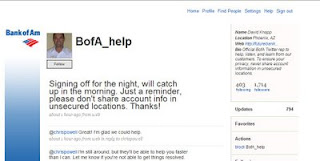
A good example of a bank that gets it is Bank of America. In January 2009, BofA launched its Twitter presence using the user ID BofA_help.


According to Holly Hastings on BofA's Future Banking Blog, "with the advent of social networking sites and blogs, companies have the opportunity to listen and learn from their consumers in ways that were not possible before. Companies can gain powerful knowledge on everything from product enhancements, customer service interactions and unresolved problems–but only if they listen. Social networking sites like Twitter enable that listening in real time." Other tweeters include UMB and Wachovia.

In a Februay 2009 ABA Banking Journal article, Pete Fields, Wachovia's senior vice-president and e-business director for corporate services and Web 2.0 said, “in August we started with Twitter because we wanted to develop a corporate competency in this type of social media. Our ‘followers’ have been very supportive about our presence on the platform. I believe they see it as a validation.” In the same article, Pamela K. Blase, senior vice-president and director of corporate communications, UMB Financial Corp., Kansas City, said that her bank started using Twitter to share information about the unfolding financial crisis.

According to the ABA Banking Journal, "the broader world of corporate Twitter users has also adopted the tool to stay in sync with their customers—and ease any daily tensions that are bound to erupt." As illustrated in the example above, a customer service strategy that utilizes Twitter (or a similar technology) can prevent every day issues from escalating into reputation damaging episodes. And the beauty of it is that Twitter communications are efficient at a maximum of 140 characters per tweet.

According to Carol Forsloff, despite the benefits of social media and Twitter, in particular, some businesses are afraid of having negative information posted - even if it is just 140 characters worth of griping. Ms. Forsloff, reminds businesses that criticism provides an opportunity to defend their business and explain their position. In the example above, the tweet allowed the bank to describe the issue not as a breakdown in the system but a scheduled outage for the purpose of maintaining the network.

So who should care about Twitter? Any bank that truly is interested in improving the customer experience. By leveraging this technology and incorporating it into an existing customer service infrastructure, banks can create considerable goodwill by demonstrating that they "get it" and are committed to dealing with customers on their terms.